How to Find the Real Pain Points Your Audience Feels
 David Zenler
Most course ideas don’t fail because the creator lacked effort. They fail because the course solves a problem the audience does not urgently feel.
That can be difficult to hear when you’ve spent weeks planning lessons, recording videos and creating worksheets.
You might have built something useful. You might even have built something your audience genuinely needs.
But if your audience doesn’t recognise the problem in the way you describe it, they won’t immediately understand why they should buy.
The problem is rarely that you need another clever funnel.
It’s usually that you’re talking about the problem in your language rather than theirs.
What Is an Audience Pain Point?
An audience pain point is a specific problem, frustration or obstacle that someone wants to resolve.
But there’s an important difference between a problem someone has and a problem someone feels.
A creator might have inconsistent marketing.
That’s the problem they have.
What they feel might sound more like this:
“I’m exhausted from posting every day and still hearing nothing back.”
That second version carries frustration. It sounds personal. You can picture the person saying it after another disappointing week.
That’s felt pain.
Felt pain matters because people act on problems they can recognise, describe and emotionally connect with.
Why Course Creators Often Solve the Wrong Problem
Imagine a creator who teaches photography.
She notices that many beginners struggle with camera settings, so she creates a complete course explaining aperture, shutter speed and ISO.
The lessons are accurate. The videos are polished. The worksheets are clear.
But the course barely sells.
Why?
Because her audience wasn’t waking up thinking:
“I need a detailed understanding of the exposure triangle.”
They were thinking:
“Why do my indoor photos always look dark and blurry?”
The creator built the course around the technical problem. Her audience was experiencing the frustrating result.
She was close.
But being half right can still mean missing the sale.
A course about camera settings sounds like work. A course that helps parents take bright, sharp photographs of their children indoors sounds like a result they already want.
The information inside could be almost identical. The recognised problem is completely different.
Assumed Pain Versus Felt Pain
Most creators begin with assumed pain.
You know your subject. You understand the mistakes beginners make. You can often see problems your audience hasn’t noticed yet.
That knowledge is useful, but it can also become a trap.
You start deciding what people need without checking what they’re actually worried about.
For example, your audience might say they want “more students”.
That sounds like the problem, but it’s usually only the surface answer.
What does having too few students actually mean to them?
Perhaps they’re embarrassed because their last launch produced two sales.
Perhaps they’re tired of spending hours creating social posts that disappear without a response.
Perhaps they’re beginning to wonder whether anyone wants what they teach.
Those are very different frustrations. Each one could lead to different content, course positioning and offers.
Look at the main problem you currently believe your audience has.
Now ask yourself one honest question:
Have I heard people describe this problem, or have I decided they have it?
Mark your answer:
- A for assumption
- E for evidence
Many people will begin with an A.
That’s fine. An assumption isn’t useless. It’s simply a hunch that still needs testing.
Where to Find Your Audience’s Real Problems
The best audience research often happens where people are talking to each other rather than talking directly to you.
When someone answers your formal customer survey, they may try to give a sensible or helpful response.
When that same person is complaining in a community group, replying to a friend or leaving a comment under a video, the words are often far more honest.
Keep your eyes open. Your audience is already telling you what it needs.
Look Inside Relevant Communities
Online communities can show you what people repeatedly struggle with.
These might include:
- Facebook groups
- Reddit communities
- membership forums
- professional communities
- specialist discussion boards
- comments beneath popular posts
Don’t enter these spaces looking for an excuse to promote your course.
Observe.
Look for questions that keep returning. Notice what people complain about, what they’ve already tried and what they’re tired of hearing.
A comment such as this tells you much more than a broad survey answer:
“Everyone says to build an email list, but nobody explains what I’m meant to send once people join.”
The surface topic is email marketing.
The felt problem is being given incomplete advice and then feeling lost.
The words “nobody explains” are particularly useful. They tell you that the person feels overlooked.
Read Video and Podcast Comments
Popular videos and podcast episodes attract people who are already interested in a subject.
Read the comments beneath content that addresses the problem you teach.
Pay attention to people who say:
- the advice didn’t work for them
- they’re still confused
- they wish the creator had explained something else
- they’ve tried several approaches
- they don’t know what to do next
Don’t only read the most popular comments. Some of the best clues are sitting inside long replies and side conversations.
Use Search Autocomplete
Search autocomplete is your audience finishing the sentence.
Start typing a phrase connected to your subject and see what appears.
For example:
- “Why does my online course…”
- “How do I get students to…”
- “Why is nobody buying…”
- “I created a course but…”
The suggestions won’t tell you everything, but they can reveal the language people commonly use when searching.
You can also look at related searches and question boxes for more specific wording.
Use these as clues rather than final proof. A phrase becomes much more useful when you also see it appearing in communities, comments or your own inbox.
Review Your Own Emails and Webinar Questions
Your best research source may be closer than you think.
Look through:
- email replies
- support questions
- discovery call notes
- webinar questions
- community posts
- coaching call notes
- sales call objections
Which questions appear repeatedly?
What do people ask just before they buy?
What almost stops them from buying?
What do they confess after they’ve been talking for ten minutes and begin to relax?
These are not interruptions to your work. They are research.
Ask One Good Open Question
You can also ask your audience directly.
Avoid questions such as:
“Would you buy a course about content marketing?”
People often say yes because they want to be supportive. It doesn’t mean they will pay for it.
Ask about their real experience instead.
A stronger question would be:
“What is the most frustrating part of trying to create content consistently?”
Other useful questions include:
“What have you tried so far?”
“What keeps getting in the way?”
“What do you wish someone would explain properly?”
“When did this last happen?”
The final question is especially useful because it encourages someone to describe a real event rather than give you a vague opinion.
Choose two research routes to use this week.
For example, you might study a community and review your email replies. Or you might search video comments and send one open question to your list.
Two routes are enough.
What to Listen for During Pain Point Research
Finding conversations is only the first step.
You also need to recognise which words matter.
The strongest audience language usually contains emotion, repetition or a clear sign that the person feels stuck.
Listen for Emotional Language
Compare these two statements:
“I need to improve my course marketing.”
“I’m so tired of promoting my course and feeling as though I’m talking to nobody.”
The first statement describes a general problem.
The second describes felt pain.
Words such as tired, frustrated, worried, confused, embarrassed and overwhelmed show you how the problem affects the person.
You’re not looking for dramatic language for the sake of it. You’re looking for honest signs that the issue matters enough for someone to seek a solution.
Watch for These Four Flag Phrases
Certain sentence openings frequently lead to useful customer language:
- “I just want to…”
- “I’m so tired of…”
- “Why does it always…”
- “Nobody tells you…”
Write these four phrases at the top of your research document.
Whenever you see someone using one of them, slow down and read the rest carefully.
For example:
“I just want to know whether my course idea is worth building before I spend months creating it.”
That one sentence contains a desired outcome, a fear and a buying motivation.
The desired outcome is confidence.
The fear is wasting months.
The possible offer is a simple course validation process.
Look for Repetition
One complaint can be interesting.
Ten people describing the same frustration in slightly different ways is a signal.
You don’t need hundreds of responses before you act. Small patterns are still useful, especially when the people speaking closely match the audience you want to serve.
Record repeated ideas even when the wording is different.
For example:
- “I don’t know what to include.”
- “My course keeps getting bigger.”
- “I’m worried I’ve left something important out.”
- “I’ve been outlining it for six months.”
These may all point towards one deeper problem: the person doesn’t know how to define a clear course scope.
Separate Nice-to-Haves From Sticking Points
People enjoy talking about things they would like.
That doesn’t always mean they care enough to change them.
A nice-to-have might sound like:
“It would be good to make my videos look more professional.”
A real sticking point might sound like:
“I keep delaying my launch because I hate how I look and sound on camera.”
The second problem is stopping progress.
That matters.
A useful pain point often has a consequence attached to it. It costs the person time, money, confidence, energy or momentum.
Capture the Exact Words Your Audience Uses
Once you find useful phrases, don’t immediately tidy them up.
Copy them word for word.
Creators often take a raw, honest sentence and turn it into marketing language.
Someone says:
“I have notes everywhere and I can’t work out what should actually go in the course.”
The creator rewrites it as:
“Develop a streamlined curriculum architecture.”
The meaning may be similar, but the recognition has disappeared.
Your audience doesn’t describe its Tuesday afternoon frustration as a curriculum architecture problem.
Use the words people naturally use.
Create a Simple Customer Language Swipe File
You don’t need a complicated research system.
A spreadsheet, document or note is enough.
Create these columns:
- Exact phrase
- Where you found it
- Main problem
- Emotion
- How often it appears
- Possible content or offer idea
Here’s a simple example:
| Exact phrase | Main problem | Emotion | Possible use |
|---|---|---|---|
| “I keep adding lessons because I’m scared the course won’t be good enough.” | Course scope | Fear | Blog about knowing when a course has enough content |
| “I post all week and nobody asks about my programme.” | Content isn’t converting | Frustration | Email subject line or webinar topic |
| “I don’t want to spend three months building something nobody buys.” | Course validation | Worry | Course validation checklist |
This file later becomes one of your most valuable content resources.
It can help you write:
- blog titles
- lesson hooks
- email subject lines
- webinar topics
- lead magnets
- sales page headings
- social posts
- course names
This is simple to do. The value comes from using it consistently.
Turn Scattered Clues Into One Clear Problem
At first, your research may look messy.
You’ll have comments, questions and complaints that seem only loosely connected.
Your next job is to cluster them.
Place similar phrases together and ask:
What bigger problem could explain all of these comments?
You might find phrases such as:
- “I don’t know what to post.”
- “I run out of ideas every week.”
- “Everything I write sounds repetitive.”
- “I spend hours staring at a blank document.”
You could name the cluster “content idea generation”.
But that still sounds like your language.
A more audience-focused version might be:
Never knowing what to say when it’s time to promote your course.
Now you have something specific, recognisable and emotionally accurate.
Choose Problems That Are Frequent and Painful
Not every problem deserves a course.
When deciding which issue to lead with, consider two things:
- How frequently does the problem appear?
- How strongly does the problem affect the person?
A frequent but mild annoyance may make a useful social post.
A painful but uncommon problem may suit a specialist service.
A problem that is both frequent and painful could support a workshop, lead magnet, course or larger offer.
You can use a simple scoring system:
- Frequency: 1–5
- Emotional intensity: 1–5
- Cost of leaving it unsolved: 1–5
- Relevance to your expertise: 1–5
This isn’t a scientific formula. It simply helps you stop choosing ideas based only on personal enthusiasm.
A Worked Example: From Raw Comment to Course Hook
Let’s look at the full process.
Imagine you find these comments from aspiring course creators:
“I’ve got three different course ideas and I keep changing my mind.”
“Every time I choose a topic, I convince myself nobody will buy it.”
“I wish I could test the idea without building the whole course.”
Step 1: Identify the shared problem
The shared problem is uncertainty about which course idea to pursue.
Step 2: Identify the emotional layer
The emotional layer is fear of wasting time and choosing incorrectly.
Step 3: Capture the desired outcome
They want evidence that an idea is worth developing before they build it.
Step 4: Create the hook
A weak hook might be:
“Learn course validation strategies.”
A stronger hook might be:
“Find out whether your course idea has real demand before you spend months building it.”
The stronger version works because it connects the method to a consequence the audience already wants to avoid.
That is the difference between describing your expertise and describing the result your audience recognises.
Turn Your Assumption Into a Hunch to Test
Return to the problem you wrote at the beginning.
Instead of stating it as a fact, rewrite it as a hunch.
For example:
“My audience needs help with email marketing.”
Becomes:
“I think my audience feels frustrated because they don’t know what to send after someone joins their email list.”
That is much easier to test.
You can now look for the exact frustration in comments, questions, emails and search phrases.
You may prove the hunch right.
You may discover that the problem is slightly different.
Either result is useful.
Remember, research isn’t about proving that your first idea was clever. It’s about getting closer to what people genuinely need.
Your Pain Point Detective Challenge
Your task this week is to collect 10 real phrases from your audience.
Choose two research routes and copy each phrase word for word.
Don’t try to write the perfect offer yet.
Don’t build a full sales page.
Don’t disappear into a complicated research project.
Find ten phrases.
That is the win.
Once you have them, choose the strongest phrase and turn it into one content or course hook.
For example:
Raw phrase:
“I keep changing my course idea because I don’t know which one people will pay for.”
Possible hook:
“How to choose a course idea people will pay for without spending months building it first.”
The hook doesn’t need to be perfect. It gives you something grounded in evidence rather than guesswork.
Learn How to Do This Live
Finding audience pain points becomes much easier when you can see the process in action.
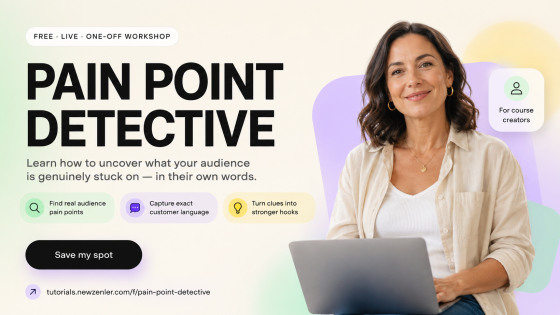
That’s why we’re running Pain Point Detective, a free, one-off live session for course creators.
During the session, we’ll show you how to:
- find places where your audience speaks honestly
- tell assumed pain from felt pain
- recognise language that signals genuine frustration
- capture the exact words your audience uses
- turn those words into clearer content and course ideas
This is for you whether you haven’t launched yet or you’ve launched before and couldn’t work out why the offer didn’t land.
No previous experience is needed. Bring the topic you teach and an open mind about what your audience might actually want.
Save your free spot for the Pain Point Detective workshop
Frequently Asked Questions
What is a pain point in marketing?
A pain point is a specific problem or frustration experienced by a potential customer. The strongest pain points usually affect someone’s time, money, confidence, energy or ability to make progress.
How do I find my target audience’s pain points?
Look at relevant communities, comments, email replies, webinar questions, customer conversations and search suggestions. Record the exact phrases people use and look for repeated frustrations rather than relying on a single comment.
Should I ask my audience what course they want?
You can, but broad questions often produce vague or overly polite answers. It’s usually more useful to ask what they’re struggling with, what they’ve already tried and what keeps getting in the way.
How many audience responses do I need?
You don’t need hundreds of responses to begin spotting useful patterns. Start with ten genuine phrases from people who closely match your audience, then continue adding to your research as you create and sell.
What is the difference between a problem and a felt problem?
A problem describes the practical issue someone has. A felt problem includes the frustration, worry or consequence attached to it. For example, “I need to improve my marketing” is a problem, while “I’m tired of posting every day and getting no enquiries” is felt pain.
Can audience pain points help me write better content?
Yes. Your audience’s own language can help you write more relevant blog titles, emails, social posts, course lessons and sales pages. The aim isn’t to manipulate people. It’s to describe the problem clearly enough that the right person recognises it.
Your Next Step
Write down the problem you’re most certain your audience has.
Then ask yourself whether it came from assumption or evidence.
Choose two places to investigate and collect ten real phrases this week. Stop there. Ten honest phrases will teach you more than another afternoon spent trying to invent the perfect course title.
And when you’re ready to see the method demonstrated step by step, join us for the free Pain Point Detective live session.
Already planning your next course? You can also try Zenler risk free for 30 days and access the Accelerator Program to guide you through the next steps.
Categories: : Course Creation, Zenler Course Creation
Copyright © 2026 Zenler. All rights reserved.
Terms | Privacy Policy | Cookie Policy | Support