Sophie Bee: How a Messaging Strategist Built a Coaching Business That Converts with Zenler
 David Zenler
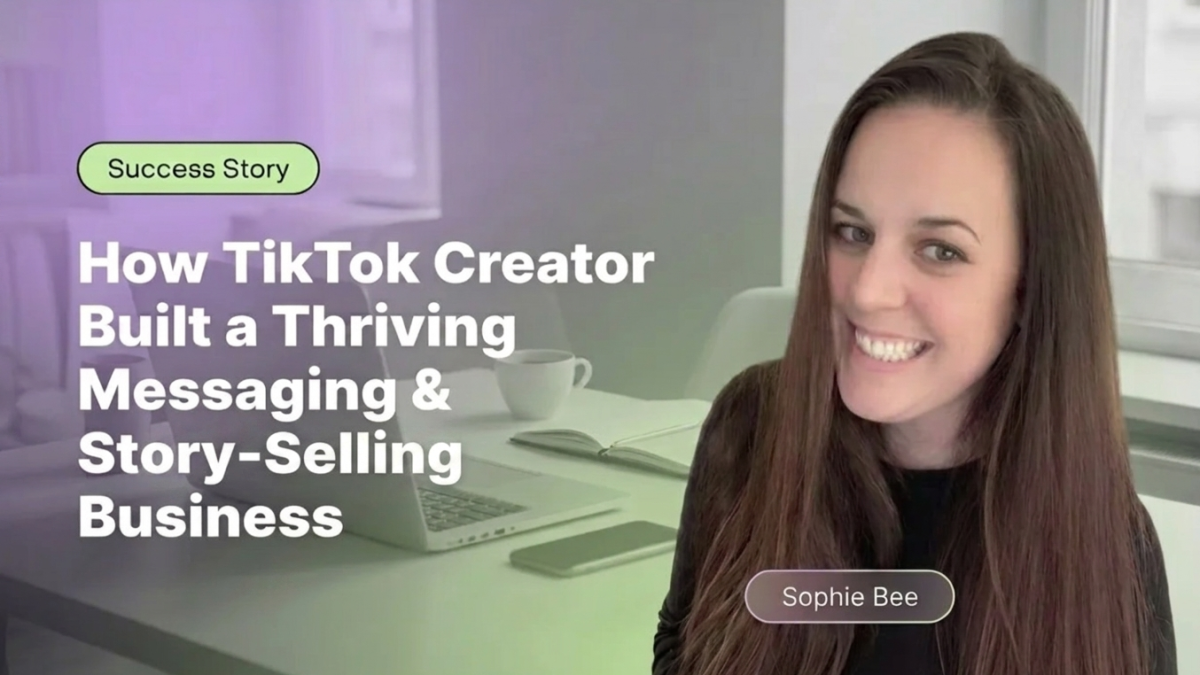
See how Sophie Bee used Zenler to build high-converting sales pages, run coaching funnels & grow a messaging and story-selling business that converts.
Sophie Bee did not plan to become a messaging and story-selling strategist. She started on TikTok, telling her story in a way she would never recommend to anyone now, and accidentally grew an audience of 30,000 people. Those people started asking her for help. She did not have a clue how to help them — so she went and got her coaching credentials, built her first program, filled it up, and then discovered that the people inside it did not actually want what she was teaching them.
They wanted to know how she was doing it.
That pivot — from teaching what she knew to teaching how she built — is where Sophie's real business was born. And it has been growing ever since, built on a foundation of genuine relationships, sharp messaging, and a refusal to pretend that building a business online is simpler than it actually is.
She is also, for the record, a former cake designer. So her path to becoming one of the most respected voices in online coaching and marketing has been, in her own words, a ball of yarn that has been torn apart and thrown on the floor.
From Cake Designer to Coaching Strategist
Sophie's first business was a cake design company. What made it successful, she says, was not the cakes — it was what she was doing online to market them. That thread has followed her ever since.
She came into the coaching space around 2020, during the pandemic boom, when everyone with a skill and a social media account seemed to be launching something. Sophie landed on TikTok and started sharing her story — not polished, not strategic, just honest. She grew quickly.
"Those women started asking me, can you help me? And the answer was, well, no, because I haven't got a clue how to help you do this stuff. But that's when I was like, you know what, I could."
She got her coaching credentials, launched her first program, and filled it. But a pattern emerged immediately. The people inside the program were not there for the content she was teaching. They were there because they wanted to know how she was signing clients, writing pages, and running programs.
"I said, well, look, don't hack my funnels, let me just teach you."
And with that, her real business was born.
The Business She Runs Today
Sophie describes herself as a messaging and story-selling strategist. She works with coaches, consultants, and service providers who are showing up online, posting content, running funnels, and doing all the things — but not signing clients.
The problem, she says, is almost always the same. They cannot articulate what they do. The offer is unclear. The messaging is not attracting the right people. And because the foundation is shaky, everything built on top of it — the funnels, the social media, the sales pages — is working against them rather than for them.
"The very first things we do is, right, let's take a look at what are you actually offering people. And then, how do we put words to that to attract people?"
From there, the work expands into the full sales and marketing picture: social media strategy, sales calls, funnel setup, and how to use content as a genuine business asset rather than noise.
She works with clients at different stages and across different price points, and she is clear that the journey her clients go on mirrors the journey she has been on herself — which gives everything she teaches a credibility that is hard to manufacture.
How Sophie Found Zenler
Sophie's introduction to Zenler came through her mum.
Before Zenler, Sophie's business was spread across multiple tools. Zoom for calls. Separate landing pages — she was paying per page. Email in one place. Everything fragmented and expensive.
Her mum had found Zenler while setting up her own coaching platform, and mentioned it. Sophie was sceptical at first but took a look.
"I'm so used to Zenler now, but I had them all over the place, and it was costing a fortune. My mum said, oh, I've found this thing, Zenler, it's got all of that you're talking about. I was like, no. Anyways, I looked, and I was like, well, this is easier."
The cost alone was a convincer. She had been paying per landing page. Zenler gave her unlimited pages, email, courses, and funnels in one place for a fraction of the price.
She has been a member since the early days — on founder's member pricing — and has watched the platform grow significantly since she joined.
How She Uses Zenler
Sophie is honest about the fact that she has probably explored around ten percent of what Zenler can do. She uses it with focus rather than breadth — and what she uses, she uses very well.
Her primary use cases are lead magnets and marketing funnels, and courses and sales pages.
The sales pages are where she has put the most thought and energy. As someone who teaches the psychology of messaging and selling, the quality of a sales page matters enormously to her — not just aesthetically but functionally.
"I love the sales pages, because they're just so easy to use. The flexibility of them — to be able to do whatever I want creatively, without having to finick around with all the little pieces. It just works."
She also uses Zenler's course funnels in a way that many people do not — not as an end destination, but as the beginning of the sales journey. The course funnel is a lead-in that warms people up before moving them toward higher-ticket offers.
During the interview, David introduced her to Zenler's branching survey feature inside the marketing funnels — and she immediately saw the application. She had tried to build something similar herself years ago and it had been a disaster. Now it was built in and ready to use.
"I will play with that. That's definitely something I'm going to go and play with now."
Why She Recommends Zenler
Sophie does not just use Zenler herself — she actively tries to move her business partners and clients onto it too.
She has seen behind the curtain of multiple platforms at this point, and the comparison is not flattering to the alternatives. She describes one platform that caused a catastrophic launch failure for a client — the system triggered a spam filter during an active launch, kicked the client out, and wiped their entire contact list. It happened twice. To two separate clients. On the same platform.
"I've lost so much money with these hiccups, and I can thankfully say I've not had these hiccups with Zenler."
Stability matters. When a platform breaks, it does not just break for the business owner — it breaks for every client trying to access their content, every prospect mid-funnel, every sale in progress. Zenler has not done that to her.
Her Relationship with AI
Sophie uses AI — but on her own terms.
She refuses to use it to write her content. Her voice is too specific, too intentional, and too personal for that. She has found that ChatGPT tends to smooth out exactly the irregularities that make her writing feel like her — and she sometimes puts those irregularities back in deliberately after editing.
"My voice comes out in some of the irregularities of how I write. Sometimes I will literally put the mistakes back in, or the weird lines, so that it sounds like me."
What she does use AI for is pattern recognition. She feeds in transcripts from sales calls and coaching calls, and asks it to identify patterns in what her clients say — which helps her understand her own methodology more clearly than she could by reviewing calls manually.
She also uses it for brainstorming, refining sales page copy, and processing ideas. But she always has the first and final say.
"I always have the first say and the final say, unless it really is a lot better than what I would have written. But you can usually tell."
Her Confidence Journey
Sophie is visibly confident now. But she is honest about the fact that she was not always.
There was a period in her life where she struggled to phone and order food because she was afraid of getting it wrong. Her confidence, she says, has come in waves — built up, knocked down, built again. When she first came back online, she was hiding behind content rather than owning her voice.
"I had confidence in one area, in so much as I was kind of naively telling my story, but hiding behind the content I was creating. I didn't have the confidence in what I was doing, selling, saying, connecting."
She found her voice through writing first. Then, gradually, the writing and the speaking came together, and she realised the things she was afraid to say out loud were the same things she had already been putting on the page.
The lesson she draws from that — and teaches to her clients — is that people-pleasing content does not sell. The more you try to soften your message so it does not offend anyone, the less it attracts anyone either.
"The more I say it in my way, the more it attracts and repels — which is exactly what content is meant to do."
Her Biggest Tips
Sophie does not hold back when she shares what she knows. Three pieces of advice stand out from this conversation.
The first is to build it backwards. Most people try to start with low-ticket offers, build up through a long ascension model, and eventually get to high-ticket. Sophie argues this is the hard way around.
"Build the high-ticket thing first. Get really good at selling that. Get really good at your craft. Then you'll have the money to pay for all the low-ticket things, and you'll have the audience to sell them to."
The second is to sell before you build. Sophie has never launched a program she built entirely in advance. She sells first — at founder or beta pricing — builds with the clients in real time, and ends up with a course shaped by real people that works better and comes with built-in messaging.
"Go and sell it. You give them the founders prices, the beta prices, whatever you call them. People love it, because they're part of it."
The third is to treat content as an asset. One single piece of content, written with the right messaging and put in the right place, can book 27 sales calls. Sophie has done exactly that. A piece like that becomes something you can reuse, repurpose, and build on — not something you produce and throw away.
"Content should be an asset. You should be able to have a really great piece of content that converts and does whatever you need it to do."
What Is Next for Sophie
Sophie's business continues to evolve in response to what her clients need. That has always been the pattern — listen, respond, build, and take people with you as you grow.
She is planning to explore Zenler's branching funnel feature to create a qualifying pathway for people coming into her world. She has had the idea for years — building a diagnostic that routes people to the right offer based on where they are in their journey — and now the tool to do it properly is right there in the platform she is already using.
She is also focused on growing the depth of her client relationships, developing new offers in response to what her existing clients are asking for next, and continuing to be one of the most prolific and honest voices in the online coaching and marketing space.
"You work it till it works. It's not a case of if, it's just a case of when."
What Business Owners Can Learn from Sophie Bee
Sophie's journey is one of the most practically useful in this entire series — not because everything went smoothly, but because of how she has thought about every stage of it.
A few things stand out.
Build high-ticket first. The skills, the tech, the volume needed for low-ticket are significantly more demanding than most people realise. Starting with fewer, better-paying clients gives you the runway to build everything else properly.
Sell before you build. Validated offers built with real clients in real time outperform everything built in isolation. The messaging practically writes itself.
Your content has one job. It should be attracting your people and repelling everyone else. If it is trying to please everyone, it is working for no one.
Your voice is the product. Sophie's irregularities, her specific turns of phrase, her way of saying things — these are not mistakes to be corrected. They are the reason people choose her over anyone else.
Relationships accelerate everything. Every major pivot in Sophie's business has come from tuning back into her clients and listening to what they actually need next. The best clients are already in your audience.
"I always say this — your best clients are already in your audience. They're not on a different planet somewhere. They're here."
Connect with Sophie Bee
📘 Facebook: https://www.facebook.com/SophieBSocial
📸 Instagram: https://www.instagram.com/its.me.sophie.bee
🏆 The Premium Buyer Bootcamp: https://highticketclientsonrepeat.com
FAQ
Who is Sophie Bee? Sophie Bee is a messaging and story-selling strategist who helps coaches, consultants, and service providers articulate their offers, attract the right clients, and build businesses that convert. She has been in the online coaching space since around 2020 and works with clients across a range of price points and business stages.
What does Sophie Bee teach? She teaches messaging, offer clarity, content strategy, sales, and the full client acquisition process — from how to attract the right people through social media to how to convert them through funnels and sales calls.
Who does Sophie Bee help? She helps coaches, consultants, and service providers who are already showing up online but struggling to sign clients — usually because their offer is unclear, their messaging is not attracting the right people, or they are missing key pieces of their sales process.
Why is Sophie Bee's success story important? Her story shows what is possible when someone listens to their market, builds from genuine expertise, and refuses to follow formulas that do not serve them or their clients. She has built a thriving business by doing things her own way — and she teaches others to do the same.
Why did Sophie choose Zenler? Her mum introduced her to Zenler when she was still paying per landing page and running everything across multiple disconnected tools. The all-in-one setup and significantly lower cost made the decision straightforward.
What Zenler features have made the biggest difference for Sophie? Sales pages and marketing funnels have been her primary tools. She values the flexibility of the sales page builder and uses course funnels as entry points into her higher-ticket offers rather than as end destinations.
What is Sophie's biggest tip for new course creators? Build it backwards. Start with your highest-ticket offer, get proficient at delivering and selling it, and use the revenue and client experience to build your lower-ticket products properly — with the right messaging already proven.
How does Sophie use AI in her business? She uses AI for pattern recognition in sales and coaching call transcripts, brainstorming, and refining copy — but always writes her own content first and retains the final say. She does not use AI to replace her voice.
What can other business owners learn from Sophie's journey? Sell before you build, treat your content as an asset rather than output, let your voice attract and repel rather than trying to please everyone, and always listen to what your existing clients are asking for next.
Categories: : Success Stories
Copyright © 2026 Zenler. All rights reserved.
Terms | Privacy Policy | Cookie Policy | Support