Train AI to Write in Your Voice: Workshop Breakdown
 David Zenler
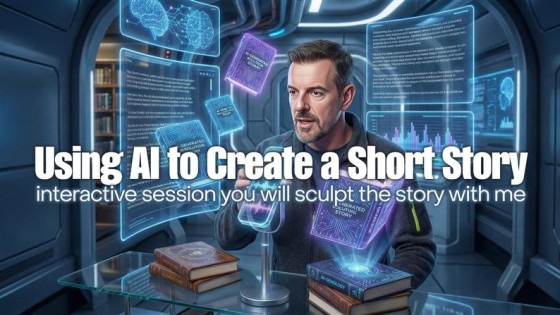
Learn how creators can train AI to write closer to their brand voice using examples, rules, prompts and review workflows.
What this training covers
This training explains:
Quick answer: how do you train AI to write in your voice?
Train AI to write in your voice by giving it strong examples of your own writing, asking it to identify your tone, rhythm, phrases, sentence length, and point of view, then using that voice profile before every draft. The goal is not to let AI replace your judgement; it is to help AI start closer to the way you naturally explain ideas.
For course creators, this is useful for lessons, emails, video scripts, community posts, sales pages, and blog content. Keep a short voice guide, review the output, remove generic phrases, and publish through your own platform so your teaching style stays consistent across the student journey.
- How to create voice samples that AI can learn from and replicate
- The difference between letting AI write generically versus training it with your specific style
- Why AI memory settings can interfere with consistent voice training
- How to use story snapshots instead of full narratives to guide AI content generation
- The fundamental prompt building blocks that improve AI output quality
The Real Problem with AI-Generated Content
In the workshop, David demonstrates how to use short writing samples, voice imprints, and iterative prompts to move AI away from generic output and closer to your own teaching style.
Key points to cover:
- AI as pattern recognition system
- The importance of voice training
- Story snapshots approach
- Two different style examples (cockney vs visionary)
- Prompt building blocks
- Practical demonstrations with Chat GPT and Gemini
- Memory settings issue
- Projects vs general chat
- Chat vs GPTs vs Agents
Most people approach AI the wrong way. They open Chat GPT, type a request like they're texting a friend, and wonder why the output sounds robotic.
The truth is simpler than you think. AI is a pattern recognition system. It's really good at guessing what comes next. Little Red Riding... and it fills in Hood. Humpty Dumpty sat on a... and you get Wall.
That's all it's doing with your content requests too. Looking at patterns, making educated guesses, filling in gaps.
But here's where it gets interesting. If you feed AI your actual writing style first, it stops guessing randomly and starts guessing based on you.
Why Voice Imprints Change Everything
During a recent workshop, David demonstrated something most people miss entirely. He wrote two completely different writing samples, both genuinely his voice, no AI involved.
The first sample used cockney slang. Knock Down Ginger. Scarper. Got a nip on the buttock. Direct, cheeky, old school charm.
The second went visionary. Deep in the green forest. Wind rustled softly through branches. Creeks sounded like an old man getting up in the morning. Descriptive, visual, almost poetic.
Same person. Completely different voices. Both authentic.
Then he fed each sample to AI separately with the same story outline. The results were night and day. One output matched the slang perfectly. The other stayed atmospheric and descriptive throughout.
This wasn't accident. This was AI doing what it does best—recognizing patterns. But instead of generic internet patterns, it recognized David's specific patterns.
The Story Snapshot Method
Most people think they need to write entire detailed prompts. David proved otherwise during the workshop by building a story collaboratively with participants.
Each person contributed a single snapshot. One sentence. One moment.
- The sirens were jarring, waking Angela from a dead sleep
- I looked at the mirror and didn't see myself
- The dragon was actually a sea lion enjoying the morning
- Abruptly she opened her eyes to daylight, realizing her alarm was sounding
Random moments. No smooth transitions. Just key beats.
Then AI filled everything in between. It connected the dots, maintained the voice from the sample provided, and created a complete narrative.
The lesson: you don't need to write everything. You need to give AI the key moments and your voice pattern. It handles the rest.
Memory Settings Are Sabotaging Your Results
Here's something critical that most people overlook. Chat GPT has memory settings. If you've never checked yours, you probably have hundreds of saved memories in there.
David keeps his turned off completely. Why? Because memory pulls from everywhere. That salad you mentioned six months ago might influence today's dinner recommendation. That project from last year might bleed into today's work.
When you're training AI to match a specific voice, you want control. You want it learning only from what you give it right now, not from random conversations scattered across time.
Check your settings. Go to personalization. Click manage memory. Look at what's stored. If you want consistent voice training, consider turning it off.
Projects Keep Everything Contained
Instead of relying on memory, David uses Chat GPT Projects. Each project only sees the files inside it. Nothing else.
His clone project has two files that tell AI everything about him. When he asks questions there, it only uses those files. It doesn't look at his Zenler branding project or anywhere else.
This is control. This is how you train AI to be consistent instead of unpredictable.
For content creators, this means you can have a project just for your writing voice. Upload your voice samples. Upload your content DNA. Every request in that project gets filtered through your style, not through some random memory from three months ago.
The Prompt Building Blocks That Actually Matter
David broke down prompt structure into components. Not all are required, but two are essential every time: task and context.
Task means what you want AI to do. Write a message. Create an image. Generate a blog outline.
Context means what information you're providing. The story text. The audience details. The specific constraints.
Beyond those two, you can add style (humorous, professional), role (act as my editor), goal (make them understand dinner will be late), type (email, blog post), target audience (family, business clients), multipliers (give me five versions), template (use this voice sample), and examples.
Most people skip context entirely. They give task alone and wonder why results vary wildly.
The image generation demonstration proved this. When David wrote vague prompts, he got three-legged characters and persistent pigeons. When he gave specific context, he got exactly what he wanted in one attempt.
From Story to Visuals in Minutes
After creating the story with participant snapshots and AI filling the gaps, David moved to image generation using Gemini's Nano Banana feature.
The process was straightforward. Take the completed story. Ask AI to extract three key moments and write prompts for them. Don't write the image prompts yourself—let AI do it because AI knows what AI wants.
The prompts came back detailed and specific. Simpson-style cartoon. Yellow skin. Messy bedroom. Mirror reflecting everything except her.
Then he fed those prompts directly into image generation. The results matched the story perfectly. Same character consistency. Same tone. Same visual style.
One participant addition—the dragon being a sea lion—threw things off slightly because it was too bizarre for AI to reconcile logically. But that's the point. When your snapshots make internal sense, AI handles them smoothly. When they jump randomly, you see the seams.
David then showed something remarkable. He asked Gemini to combine all the generated images into comic book style. It created a multi-panel layout automatically, turning individual scenes into a complete visual story.
This entire process—story creation, voice matching, image generation, comic layout—took maybe fifteen minutes total. No designers. No illustrators. Just clear prompting and voice training.
Chat vs GPTs vs Agents
People confuse these constantly, so David clarified the distinctions.
Chat GPT is your conversational assistant. It talks about many things, remembers context if memory is on, helps with general queries.
Custom GPTs are tailored AI with specific rules or tools. They perform one task well. They're focused, not conversational.
AI Agents are different entirely. Agents handle things autonomously. They make decisions, communicate with other agents, trigger actions based on conditions.
The example David gave: an agent monitoring emails decides if someone is happy or wants to cancel. Based on that decision, it routes to another agent handling cancellations or another requesting reviews. No human involvement. Just decisions flowing through automated systems.
This is where AI is heading. Not just answering questions or generating content, but actually running processes end to end.
Zenler is already exploring agentic AI. Other platforms are too. The creators who understand these distinctions now won't be caught off guard when automation becomes standard.
The Real Advantage Nobody Talks About
Running AI content through detectors shows something interesting. Generic AI prompting scores 80-90% AI-written. Voice-trained AI content scores around 30%.
That's not just about fooling detectors. It's about Google's algorithms favoring human-written content. It's about readers connecting with authentic voice instead of corporate fluff.
When you train AI properly with your voice samples, the output genuinely sounds like you wrote it. Because in a way, you did. You provided the DNA. AI just assembled it.
What This Means for Content Creators
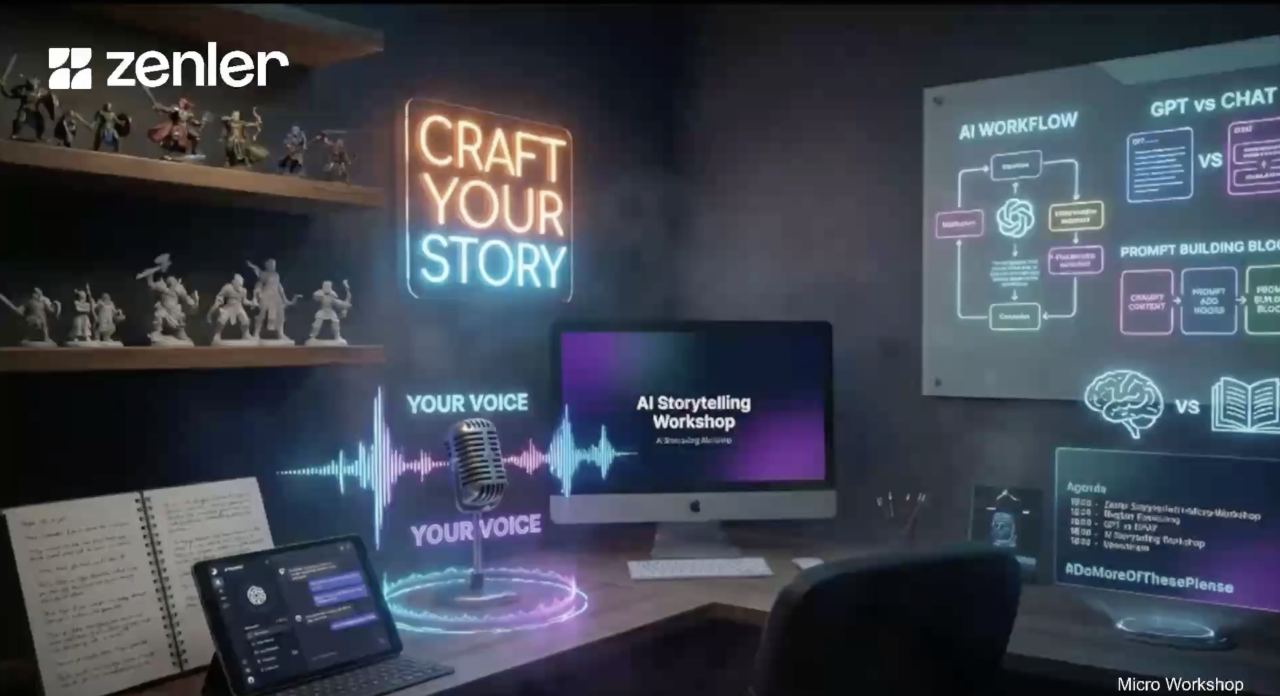
You can generate blog posts, social media content, email sequences, course materials—all in your actual voice. Not some sanitized AI approximation. Your voice.
The process isn't complicated. Write 500-1000 words in your genuine style. Don't let AI touch it except for spell check. Feed that to AI as your voice sample. Give it task and context. Watch it match your tone naturally.
Test it with different content types. Your bio. Your course descriptions. Your email newsletters. See where it nails your voice and where it needs adjustment.
Over time, as you refine the voice samples, AI gets better at matching you. Less editing required. More authentic output. More time saved.
This isn't about replacing your creativity. It's about scaling it without diluting it.
Questions answered in this training
- What is AI actually doing when it generates content?
- How do you train AI to write in your specific voice instead of generic AI style?
- Why do story snapshots work better than detailed full narratives?
- What prompt elements are essential versus optional?
- Should you keep Chat GPT memory settings on or off?
- How do Chat GPT Projects differ from general conversations?
- What's the difference between Chat, GPTs, and AI Agents?
- Can AI create consistent visual content from written stories?
Key terms explained
Voice imprint
David uses this to mean a genuine writing sample that teaches AI your specific style, tone, slang, pacing, and personality—the DNA that makes content sound like you wrote it.
Story snapshots
Key moments or beats in a narrative without transitions or connective tissue—AI fills the gaps between snapshots while maintaining your voice.
Pattern recognition
The fundamental way AI works—making educated guesses about what comes next based on massive amounts of data it's processed.
Agentic AI
AI agents that make autonomous decisions, communicate with other agents, and trigger actions without human intervention—the next evolution beyond conversational AI.
Who this training is for
This is for:
- Content creators who want AI to match their authentic voice
- Course creators building lead magnets and training materials at scale
- Anyone frustrated with generic-sounding AI output
- Educators and coaches who need consistent brand voice across platforms
This is not for:
- People expecting AI to do all creative work without voice training input
- Anyone looking for completely hands-off content generation with no style guidance
About the Author
David Zenler
A veteran of content creation, David delves deeply into the world of AI and brings you the latest developments in AI technology.
🔔 Subscribe to receive the latest insights into this crazy fast-paced sector.

1. AI is confidently wrong about facts
It'll make up statistics, quotes, and dates. Always fact-check anything verifiable.
2. AI loves clichés
"Little did she know..." "The journey of a thousand miles..." "In today's fast-paced world..." Delete these on sight.
3. AI can't do surprise
It predicts the most likely next thing. Surprise requires understanding what's unlikely but delightful. That's your job.
4. The first draft is never the keeper
If you're using AI's first output, you're basically plagiarizing the internet's average opinion on a topic.
5. Your weird ideas are your advantage
AI will always suggest the safe, middle-of-the-road approach. Your job is to push it toward weird, specific, memorable.
The Future (And Why You Should Care Now)
Agentic AI is coming—systems that can research, draft, edit, and publish entire workflows autonomously. Some already exist.
📌 What this means for you:
- If you don't understand AI basics now, you'll be unemployable in 3 years (harsh but true)
- Early adopters are building audiences 10x faster than traditional methods
- The bar for "good enough" content is rising because everyone has access to AI
But here's the twist: As AI content floods the internet, authentic voice becomes MORE valuable, not less.
The creators who win are the ones who use AI for speed but refuse to let it flatten their personality.
🎯 Your 7-Day AI Storytelling Challenge
Day 1: Write 500 words in your normal style. Save it.
Day 2: Feed those 500 words to AI with the prompt: "Analyze this writing style. List 10 specific characteristics."
Day 3: Use those characteristics to create a style guide. Test it with a new story prompt.
Day 4: Generate 3 versions of the same story in different styles. Notice the differences.
Day 5: Extract key scenes from your best story. Turn them into image prompts.
Day 6: Generate images. Edit the story based on what the images inspire.
Day 7: Publish something. Anything. Get feedback. Iterate.
Reality check: Most people will read this, nod enthusiastically, and do nothing. Don't be most people.
The Bottom Line
"AI won't replace you. But someone using AI better than you will."
The creators building momentum in 2026 are not simply publishing more AI output. They're the ones who've figured out how to make AI sound like them at 10x speed.
Your experiences, insights, and weird perspectives? Irreplaceable.
AI's ability to help you share them faster? Also irreplaceable.
Start with one lesson, email, or script. Mess up. Try again. Find your voice-plus-AI sweet spot.
The future belongs to creators who embrace technology without losing themselves in it.
Use 2026 to build a repeatable AI-assisted writing workflow that still sounds like you.
Or don't, and watch your competitors do it instead.
Related New Zenler AI writing guides
- AI tools for course creators in 2026
- AI prompts for course creators
- Use AI to plan, script, and produce content faster
- How AI works while keeping your human creativity
Take Your Skills Further: Watch the Interactive Workshop
Want to see these techniques in action? I recorded a 90-minute hands-on workshop where I:
✅ Build stories from scratch using the exact prompts above
✅ Show you the Cockney vs. Ethereal examples in real-time
✅ Generate images and demonstrate the entire workflow
✅ Troubleshoot common AI mistakes live
✅ Share downloadable prompt templates you can steal
► Watch the full workshop on Zenler's YouTube
No fluff. No theory. Just me, AI, and a lot of trial-and-error condensed into 90 minutes.
FAQ
How can creators train AI to write in their voice?
Creators can provide examples, define tone rules, explain audience context, give do-and-do-not guidance and review outputs before publishing.
Can AI fully replace human brand voice?
AI can assist with drafts and variations, but creators should review the final content so it remains accurate, human and aligned with the brand.
What should an AI voice guide include?
An AI voice guide should include audience, tone, vocabulary, examples, banned phrases, offer context and editing standards.
Categories: : AI for Course Creators
Copyright © 2026 Zenler. All rights reserved.
Terms | Privacy Policy | Cookie Policy | Support