Fast AI Ad Creation with Joel Erway
 David Zenler
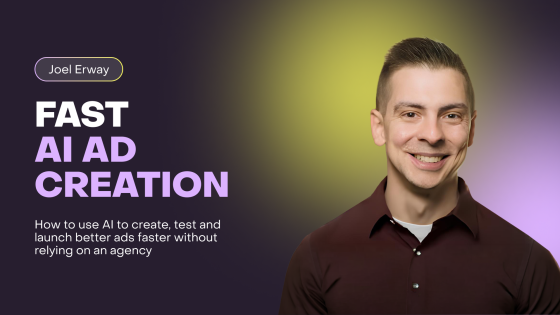
Joel Erway shows creators how to use AI to create, test and launch better ads faster without relying on an agency.
Advertising can be one of the fastest ways to grow a course, membership or digital product business.
It can also be one of the most frustrating.
Many creators do not struggle because their offer is bad. They struggle because their advertising process is too slow.
They test one ad. One headline. One image. One angle.
Then they wait.
They wait for feedback. They wait for a designer. They wait for an agency. They wait for someone to send the next version.
By the time they learn anything useful, the launch has moved on, the budget has been spent or the campaign has lost momentum.
That is why Joel Erway’s session, Fast Ad Creation Using AI Without Hiring an Agency, is such a practical part of the Future of AI for Course Creators Summit 2026.
This session is for creators who want to test faster, create better ad variations and reduce the endless waiting that often comes with outsourcing every creative decision.
Not every creator needs a big agency.
But every creator needs the ability to understand what message makes people stop, pay attention and take action.
Quick answer: Joel Erway on AI Ad Creation for Course Creators explains how to learn how Joel Erway helps course creators use AI to create, test and launch better ads faster without hiring an agency.
Why AI Ad Creation Matters for Course Creators
Course creators often have strong offers, useful expertise and a clear transformation.
But ads are a different skill.
You might be excellent at teaching your subject and still feel completely stuck when it comes to writing a paid ad.
What should the headline say?
Should the ad focus on the pain point or the result?
Should you send people to a webinar, lead magnet, challenge, waitlist or sales page?
Should the ad be direct, educational, emotional or curiosity-driven?
This is where creators can get stuck for weeks.
Think again if you believe ads are only about having a bigger budget.
Ads are about testing messages.
You need to find out what your audience responds to. You need to see which hook creates interest, which promise feels believable and which angle gets the right people to click.
AI helps because it can speed up the creative process.
It can help you generate ad angles, headlines, scripts, hooks, calls to action and campaign ideas without starting from a blank page every time.
That does not mean AI magically creates profitable ads on its own.
Please don’t treat it like that.
It means AI can help you create more options, faster, so you can test smarter.
The Real Problem with Ads for Course Creators
Most course creators do not have unlimited ad budgets or huge creative teams.
They may be running webinars, evergreen funnels, live launches, lead magnet campaigns or direct-to-offer ads with a small team.
Sometimes the “team” is just them, a laptop and a very strong coffee.
That makes speed important.
If an ad is not working, you need to test a new hook.
If a webinar registration campaign is underperforming, you may need a stronger headline.
If your creative has gone stale, you need a new version before the campaign burns through more budget.
Waiting two weeks for a new design is painful.
Waiting for someone to “circle back” can be even worse.
Joel’s session focuses on how AI can help creators move faster without hiring an agency for every campaign update.
That does not mean removing strategy.
It means giving creators more control over the testing process.
And that matters because ads improve through feedback.
If you only test one message, you learn very little.
If you test several well-structured ideas, you start to see patterns.
That is where growth becomes much more practical.
How AI Helps Creators Test Ads Faster
One of the strongest ideas in Joel’s session is testing speed.
Advertising is not usually won by one perfect ad.
It is improved through testing.
You test hooks.
You test offers.
You test creative.
You test audience angles.
You test calls to action.
You test different ways of explaining the same transformation.
AI can help course creators create more variations in less time.
For example, if you run a course on public speaking, AI could help you create ad angles around confidence, career progression, presentation skills, leadership, fear of speaking, visibility or business growth.
If you run a membership for yoga teachers, AI could help you create angles around class planning, student retention, confidence, business support, community or saving time.
If you sell a coaching programme for consultants, AI could help you test ads around lead generation, pricing, authority, sales calls, client delivery or positioning.
This is useful because most offers have more than one possible message.
You may think your course is about one thing.
Your audience may care about another.
AI can help you explore those angles quickly, then turn them into testable ad concepts.
That is a big advantage.
AI Ad Creation Without Losing Strategy
Here is where creators need to be careful.
AI can create a lot of ad copy very quickly.
That does not mean all of it is good.
Some AI-generated ads sound generic. Some overpromise. Some feel too dramatic. Some use language your audience would never use. Some miss the real reason people buy.
So the goal is not to let AI run wild.
The goal is to use AI inside a clear strategy.
Before creating ads, you still need to know:
who the ad is for
what problem they want solved
what result they want
what they already believe
what they are afraid of
what offer you are leading them towards
what action you want them to take next
AI becomes much more useful when you give it this context.
Instead of saying, “Write me an ad for my course,” you could say:
“My audience is first-time course creators who feel overwhelmed by launching. They want a simple step-by-step process and are afraid of wasting time building something nobody buys. Create five ad hooks for a free webinar that helps them validate their course idea before building the full course.”
That is a better prompt.
More specific.
More useful.
More likely to produce something worth testing.
This connects closely with David Newton’s session on AI workflow for creators, because better AI output usually starts with better direction. If your input is vague, your ads will be vague too.
Why Faster Creative Testing Matters
Ad creative gets tired.
Audiences change.
What worked last month may not work this month.
This is especially true for creators running launch campaigns, evergreen webinars or lead magnet ads. You need fresh angles, but you do not want to reinvent everything from scratch each time.
AI can help you refresh ad campaigns faster.
You can use it to create new headlines, rewrite hooks, build short video scripts, develop image concepts, test benefit-led copy, simplify your offer explanation or turn a long sales page into multiple ad angles.
That speed matters because slow testing can cost money.
If you spend too long waiting for new creative, your campaign keeps running with the same weak message.
That is not a strategy.
That is leakage.
AI helps reduce the delay between noticing a problem and testing a new solution.
Keep your eyes open here.
This can be especially useful for creators who do not want to depend on an agency for every small change.
You may still work with specialists for bigger strategy, design or scaling support. But AI can give you more control over the everyday creative testing process.
Using Proven Ad Templates with AI
A blank page is not just a writing problem.
It is an advertising problem too.
Many creators open an ad manager and freeze.
What should the first line say?
Should the ad tell a story?
Should it challenge a belief?
Should it ask a question?
Should it lead with a result?
Templates help.
AI becomes more powerful when it works from proven structures. Instead of asking it to “make an ad”, you can ask it to create variations using a specific framework.
For example, you might test:
a problem-aware ad
a transformation-focused ad
a myth-busting ad
a webinar invitation ad
a testimonial-led ad
a “before and after” style ad
an objection-handling ad
Each one has a different job.
A problem-aware ad helps people recognise the issue.
A transformation ad helps them imagine the result.
A myth-busting ad challenges a belief that may be stopping them from acting.
A webinar ad gives them a clear next step.
This is where AI can help creators become more structured in their marketing.
You are not just creating random ads.
You are creating controlled variations.
That is a much better way to learn.
AI for Ads, Funnels and Sales Copy
Ads do not work in isolation.
This is important.
A great ad cannot save a weak offer, confusing funnel or poor sales page.
If your ad promises one thing and your landing page says something different, people will leave.
If your webinar title is strong but your follow-up emails are flat, leads may not convert.
If your sales copy does not build trust, clicks will not turn into customers.
That is why Joel’s session connects naturally with Mike Samuels’ session on AI sales copy for course creators. AI can help you create ads faster, but the message still needs to carry through the whole customer journey.
Your ad should connect to your landing page.
Your landing page should connect to your webinar or lead magnet.
Your emails should connect to your offer.
Your sales page should connect to the promise you made at the start.
AI can help you keep this message consistent.
It can review your funnel for gaps. It can help you turn one core offer angle into ad copy, landing page headlines, email subject lines and sales page sections.
That is where AI becomes more than a creative tool.
It becomes a campaign support tool.
AI Ads and Organic Content Can Work Together
Some creators treat ads and organic content like completely separate worlds.
They do not have to be.
Your organic content can help you discover what your audience cares about. Your ads can help you test which messages get attention quickly.
Both can teach you something.
If a blog post performs well, it may reveal a strong pain point or search intent. If a LinkedIn post gets strong engagement, it may become an ad angle. If an ad hook performs well, it may become a blog title, webinar theme or email subject line.
This is why Neil Patel’s session on AI-powered SEO and content strategy matters too. The strongest creator businesses do not rely on one channel only.
They build connected visibility.
Organic content helps build trust and long-term discovery.
Ads help speed up testing and traffic.
AI can support both, especially when you use it to organise ideas, identify message patterns and repurpose winning angles across channels.
That is a much smarter way to market a course or membership.
What Course Creators Should Avoid with AI Ads
AI can help you move faster, but speed can create problems if you do not use judgement.
Creators should avoid using AI to make exaggerated claims, fake urgency, misleading promises or generic copy that sounds like everyone else.
Your reputation matters.
Trust matters.
If your ad promises a result your course cannot deliver, you may get clicks, but you will also create disappointment.
That is not long-term growth.
Course creators should also avoid testing too many random ideas without a clear plan.
More ads do not always mean better results.
Better testing means better results.
Start with a clear offer. Choose a few strong angles. Create variations around those angles. Watch the data. Improve from there.
This is not an overnight success.
But it is a much better system than guessing.
Practical Ways to Use AI for Ad Creation
You can start using AI for ad creation without making the process complicated.
Begin with your offer.
Then give AI the right information: who you help, what problem you solve, what outcome you promise, what objections your audience has and what action you want people to take.
From there, ask AI to help you create several ad angles.
You might ask for hooks based on pain points, desired outcomes, mistakes, myths, objections or curiosity.
Then review the results.
Remove anything that sounds exaggerated, vague or off-brand.
Keep the ideas that feel closest to your audience’s real language.
Then turn those into testable ad variations.
For example, you could ask AI to create:
five webinar ad hooks
three short video scripts
ten headline options
five image text ideas
three different calls to action
three problem-aware ad versions
three transformation-led ad versions
This is simple to do.
But the human review is not optional.
AI can give you options.
You still decide what is worth testing.
FAQs About AI Ad Creation for Course Creators
How can course creators use AI for ad creation?
Course creators can use AI to create ad hooks, headlines, video scripts, image concepts, calls to action and different campaign angles. AI can help speed up the creative process so creators can test more messages without starting from scratch every time.
Can AI replace an advertising agency?
AI can reduce the need to rely on an agency for every small creative task, but it does not replace strategy, judgement or experience. Many creators can use AI to create and test ad variations faster, while still choosing to work with experts for bigger campaign strategy or scaling.
What is the biggest benefit of AI ad creation?
The biggest benefit is faster testing. AI helps creators create more ad variations in less time, which can make it easier to discover which hooks, headlines and messages get the right audience to take action.
Are AI-generated ads always good?
No. AI-generated ads still need human review. Some AI ads can sound generic, exaggerated or off-brand. The creator should check the message, tone, promise and accuracy before publishing anything.
What should course creators give AI before asking for ad copy?
Creators should give AI details about their audience, offer, pain points, desired outcome, objections, tone of voice and campaign goal. The more context AI has, the more useful the ad ideas will be.
Can AI help with webinar ads?
Yes. AI can help create webinar ad hooks, registration page headlines, short video scripts, email subject lines and follow-up messaging. It can also help test different angles for the same webinar topic.
Final Thoughts
Joel Erway’s session, Fast Ad Creation Using AI Without Hiring an Agency, is a highly practical session for creators who want more control over paid growth.
If you run webinars, evergreen funnels, live launches, lead magnets or paid ads for your course business, this session is worth paying attention to.
AI can help you test faster, reduce creative bottlenecks and make better decisions with more data.
Remember, the goal is not to create more ads for the sake of it.
The goal is to find the messages that bring the right students into your world.
Joel’s session will help creators see how AI can make that process faster, leaner and much less painful.
Join the Future of AI for Course Creators Summit 2026 to learn how Joel Erway and other expert speakers are helping creators use AI in practical, business-focused ways.
Want to build, sell and grow your online courses, memberships and communities from one place?
Try Zenler Risk Free for 30 Days and unlock the Accelerator Program that guides you step by step toward success.
https://www.newzenler.com/register
Related AI workflow resources
Use these Zenler guides to connect AI ideas with practical course business workflows:
- How course creators can use AI agents without losing their brand voice
- AI course launch checklist for New Zenler creators
- AI agents for course creators: practical workflows and examples
Categories: : AI for Course Creators
Copyright © 2026 Zenler. All rights reserved.
Terms | Privacy Policy | Cookie Policy | Support