Mike Samuels on AI Sales Copy Without Losing Your Voice
 David Zenler
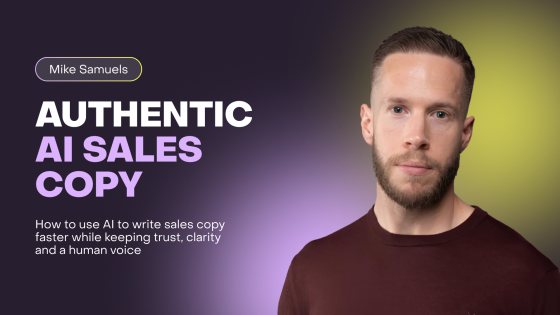
Mike Samuels shows creators how to use AI to write sales copy faster while keeping trust, clarity and a human voice.
AI can write quickly.
Very quickly.
It can produce headlines, emails, sales page sections, webinar copy, ad hooks and offer descriptions in seconds.
That sounds useful.
And it is.
But speed is not the same as trust.
For course creators, membership owners, coaches and digital business owners, sales copy has a serious job. It needs to explain the offer, build belief, answer objections and help the right person make a confident decision.
That takes more than a fast first draft.
It takes nuance.
It takes empathy.
It takes understanding the customer.
It takes a human voice.
That is why Mike Samuels’ session, How to Use AI to Write Sales Copy Faster Without Losing the Human Voice, is such an important closing session inside the Future of AI for Course Creators Summit 2026.
Because AI can help you write sales copy faster.
But you still need to make it sound like a real person who understands the reader.
Quick answer: Mike Samuels on AI Sales Copy Without Losing Your Voice explains how to mike Samuels shows course creators how to use AI to write sales copy faster while keeping trust, clarity and a human voice.
Why AI Sales Copy Matters for Course Creators
Sales copy is one of the hardest types of content for creators to write.
Not because creators do not know their offer.
Usually, they know it too well.
That is part of the problem.
When you are close to your course, membership or coaching programme, it can be hard to explain it simply.
You may focus on the modules, lessons, worksheets, calls and bonuses.
But your audience is asking something different.
Will this help me?
Is this right for me?
Can I trust you?
Will I actually use it?
Is now the right time?
What happens if I fail?
What makes this different?
Good sales copy answers those questions.
AI can help you organise those answers, but it cannot fully replace the human understanding behind them.
Think again if you believe AI sales copy is just about generating a clever headline.
The real opportunity is using AI to help you clarify the message, structure the page, test angles and write faster without losing trust.
The Problem with Generic AI Copywriting
There is a lot of bad AI copy online.
You can spot it quickly.
It sounds polished but empty.
It overuses dramatic claims.
It says things like “unlock your potential” without explaining anything meaningful.
It adds urgency where none exists.
It makes everything sound bigger, easier and more exciting than it really is.
That kind of copy may look impressive for about five seconds.
Then the reader feels the gap.
For course creators, that is dangerous.
Your audience is not just buying information. They are buying confidence in you, your method and the result you can help them achieve.
If your sales page sounds generic, trust drops.
If your emails sound like a template, people disconnect.
If your offer copy feels inflated, readers become cautious.
AI can help with copywriting, but only if you guide it properly.
You need to give it the audience, offer, tone, proof, objections, promise, boundaries and voice.
Without that, it will fill in the gaps with generic marketing language.
And nobody needs more of that.
How AI Can Help You Write Sales Copy Faster
AI is very useful for getting past the blank page.
That alone can save creators hours.
Instead of starting with nothing, you can ask AI to create a first draft of a sales page outline, email sequence, headline list, FAQ section or objection-handling section.
Then you shape it.
You remove the generic parts.
You add your examples.
You improve the language.
You make sure the promise is accurate.
You make it sound like you.
This is where AI becomes helpful.
It gives you something to work with.
For example, you can ask AI to help create:
sales page sections
offer headlines
email subject lines
webinar registration copy
launch email themes
objection-handling FAQs
guarantee explanations
benefit-led bullets
call-to-action options
short video sales scripts
That is a lot of support.
But remember, support is the key word.
AI can draft.
You decide.
Human Voice Is a Conversion Advantage
In a world full of AI-generated content, sounding human is no longer a nice extra.
It is a competitive advantage.
People are becoming more sensitive to generic content. They can feel when copy is too polished, too vague or too detached from real experience.
That means your human voice matters more, not less.
Your phrases.
Your stories.
Your examples.
Your small observations.
Your way of explaining the problem.
Your honest view of what works and what does not.
That is what makes sales copy feel trustworthy.
This connects naturally with Allie’s article on building an AI content manager for creators, because AI performs much better when it understands your voice, audience and content rules.
The same principle applies to sales copy.
If AI does not know how you sound, it will make something up.
And usually, it will sound like everyone else.
What Course Creators Should Tell AI Before Writing Sales Copy
A good AI sales copy prompt should work like a creative brief.
Do not just ask:
“Write a sales page for my course.”
That gives AI too much room to guess.
Instead, tell it:
Who the offer is for.
What problem the offer solves.
What outcome the student wants.
What they have already tried.
What they are worried about.
What your course includes.
What makes your method different.
What tone you want.
What claims to avoid.
What proof or examples you have.
This gives AI the context it needs to be useful.
For example:
“Write a sales page outline for a course that helps first-time course creators validate their course idea before building it. The audience feels overwhelmed and afraid of wasting months creating something nobody buys. The tone should be practical, reassuring and direct. Avoid hype. Focus on clarity, confidence and simple validation steps.”
That is a much stronger prompt.
The output will still need editing.
But it will be closer.
AI Can Help Find the Real Customer Objection
One of the best uses of AI in sales copy is objection work.
Creators often think the main objection is price.
Sometimes it is.
But often, the real objection is something else.
“I do not have enough time.”
“I have tried before and failed.”
“I am not technical.”
“I am not sure this will work for my niche.”
“I do not know if I am ready.”
“I already bought a course and did not finish it.”
“I am afraid I will waste money.”
AI can help you list possible objections and organise them by theme.
Then you can decide which ones are most accurate for your audience.
This is useful because strong sales copy does not ignore objections.
It answers them.
A good sales page helps the reader feel understood.
It does not pressure them.
It does not shout.
It explains.
For course creators, this matters because people are often buying a promise of change. They need to believe the change is possible for them.
AI can help you identify the doubts.
You need to answer them with honesty.
AI for Sales Pages, Emails and Funnels
Sales copy rarely lives in one place.
A course or membership offer may need a sales page, launch emails, webinar copy, checkout copy, follow-up emails, social posts, ads and FAQs.
That can feel like a lot.
AI can help keep the message consistent across the whole funnel.
You can give AI your core offer message and ask it to adapt that message for different assets.
For example, one core message might become:
A sales page headline.
A webinar title.
Three launch emails.
A LinkedIn post.
A checkout page reminder.
A short ad hook.
A FAQ answer.
This is where Mike’s topic connects well with Joel Erway’s article on AI ad creation for course creators, because ads and sales copy need to work together.
If the ad promises one thing and the sales page says something different, people lose trust.
AI can help you keep the thread consistent.
But again, you need to review the language carefully.
Consistency should not become repetition.
AI Can Help Turn Features Into Benefits
Creators often describe their offer in terms of features.
Eight modules.
Weekly calls.
Downloadable templates.
Private community.
Lifetime access.
Step-by-step training.
These things matter.
But they are not enough.
Your audience wants to know what those features will help them do.
AI can help translate features into benefits.
For example:
“Weekly live calls” becomes “get your questions answered before you lose momentum.”
“Downloadable templates” becomes “avoid starting from scratch and build faster with a proven structure.”
“Private community” becomes “get support from other creators who are building alongside you.”
“Step-by-step lessons” becomes “know exactly what to do next instead of guessing.”
That is better sales copy.
More human.
More useful.
More connected to the buyer’s real desire.
AI can help create those translations quickly, but you should make sure they are true.
Never make a benefit sound stronger than the offer can honestly deliver.
Trust comes first.
AI Sales Copy and SEO Can Work Together
Sales copy and SEO are often treated as separate things.
They do overlap.
A sales page still needs to be clear for humans and understandable for search.
A blog post can lead into a sales offer.
A comparison page can bring in ready-to-buy visitors.
An FAQ section can answer search questions and reduce buyer hesitation.
AI can help connect these pieces.
For example, Neil Patel’s article on AI SEO for course creators focuses on visibility and search intent. Mike’s session focuses on conversion and human voice.
Both matter.
Traffic without trust does not convert.
Great sales copy without visibility may never be seen.
A smart creator business needs both.
AI can support both when used strategically.
It can help you plan search-friendly content and then carry the message into your offer pages, emails and sales copy.
How to Keep AI Sales Copy Human
Keeping AI sales copy human takes intention.
Start by using real audience language.
Look at emails from prospects, comments, survey answers, sales call notes and community questions.
Use the words your audience actually uses.
Then give those phrases to AI.
Ask it to write copy that reflects those concerns without exaggerating them.
Add your own stories and examples.
Use simple language.
Cut the big claims.
Avoid fake urgency.
Make the promise clear but realistic.
Read the copy out loud.
Would you say it to a real person?
If not, rewrite it.
That simple test helps.
Sales copy should sound like a helpful conversation, not a pressure script.
AI Can Help You Write Faster, But Editing Still Matters
The editing stage is where AI copy becomes your copy.
Do not skip it.
Your first draft may be too long.
Too vague.
Too polished.
Too dramatic.
Too generic.
That is normal.
Use the AI draft as raw material.
Then ask:
Is this true?
Is this clear?
Is this how my audience talks?
Is this how I talk?
Does this answer the real objection?
Does this explain the outcome?
Does this feel trustworthy?
Would I feel comfortable saying this on a live call?
If the answer is no, improve it.
This is simple to do.
And it is where your judgement matters most.
The Risk of Overusing AI in Sales Copy
AI makes it easy to create more copy.
More emails.
More headlines.
More posts.
More funnel assets.
More variations.
But more is not always better.
A confused buyer does not need more words.
They need clearer words.
Course creators should avoid using AI to add unnecessary length, fake scarcity, inflated promises or overcomplicated messaging.
Your offer should feel easier to understand after reading the copy.
Not harder.
If AI makes your sales page longer but less clear, cut it back.
If AI adds hype, remove it.
If AI creates a claim you cannot prove, delete it.
Remember, the goal of sales copy is not to impress people with language.
The goal is to help the right person make a good decision.
Why Mike Samuels’ Session Matters
Mike Samuels’ session matters because it deals with the part of AI many creators are nervous about.
Can I use AI to write sales copy without sounding fake?
Can I move faster without losing trust?
Can I improve my offer messaging without becoming pushy?
Can AI help me explain what I sell more clearly?
The answer is yes.
But only when you stay involved.
AI can help with speed, structure, options and first drafts.
You bring the voice, judgement, accuracy and emotional intelligence.
That balance is where the magic is.
Not the cliché kind.
The useful kind.
FAQs About AI Sales Copy for Course Creators
Can AI write sales copy for course creators?
Yes. AI can help course creators write sales pages, emails, headlines, webinar copy, ad hooks and FAQs. However, the creator should review and edit the copy to make sure it is accurate, human and aligned with the brand voice.
How do I stop AI sales copy sounding robotic?
To stop AI sales copy sounding robotic, give AI your audience details, tone of voice, examples, offer information, customer objections and phrases to avoid. Then edit the output with your own stories, examples and natural language.
Is AI good for writing course sales pages?
AI can be useful for writing course sales page outlines, headlines, benefit sections, FAQs and objection-handling copy. The best results come when the creator adds real customer insight, proof and clear positioning.
Can AI help with launch emails?
Yes. AI can help plan and draft launch emails, subject lines, openers, teaching emails, objection emails, urgency emails and final reminder emails. The emails should still be reviewed so they sound personal and trustworthy.
What should I give AI before asking it to write sales copy?
You should give AI details about your audience, offer, outcome, pain points, objections, tone of voice, proof, guarantee, call to action and anything you want to avoid. Better context creates better copy.
Why does human voice matter in sales copy?
Human voice matters because people buy from creators they trust. Sales copy that sounds generic, exaggerated or robotic can weaken trust. A human voice helps the reader feel understood and makes the offer more believable.
Final Thoughts
Mike Samuels’ session, How to Use AI to Write Sales Copy Faster Without Losing the Human Voice, is an essential part of the summit because it deals with one of the biggest creator challenges.
Writing copy that sells without sounding pushy, fake or generic.
AI can help you move faster.
It can help you structure your ideas.
It can help you create first drafts.
It can help you test angles.
It can help you turn features into benefits.
But your voice still matters.
Your judgement still matters.
Your understanding of the customer still matters.
That is what makes the copy work.
Use AI for speed.
Use your humanity for trust.
That is the balance creators need.
Join the Future of AI for Course Creators Summit 2026 to learn how Mike Samuels and other expert speakers are helping creators use AI in practical, human and business-focused ways.
Want to build, sell and grow your online courses, memberships and communities from one place?
Try Zenler Risk Free for 30 Days and unlock the Accelerator Program that guides you step by step toward success.
https://www.newzenler.com/register
Related marketing and funnel resources
Build a stronger creator marketing system with these connected Zenler resources:
- Complete course funnel guide for New Zenler
- Lead magnet ideas for course creators
- Online course SEO topic clusters
Categories: : AI for Course Creators
Copyright © 2026 Zenler. All rights reserved.
Terms | Privacy Policy | Cookie Policy | Support