Mike Samuels at Zenler AI Summit 2026 — Authentic AI Sales Copy for Course Creators
 David Zenler
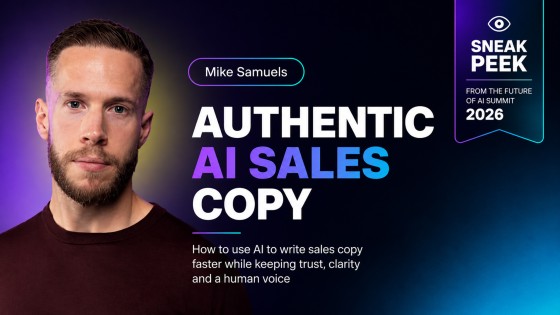
Mike Samuels shared four human voice copy strategies at the Zenler AI Summit 2026. Watch the full session through current Zenler access.
Mike Samuels has generated over $200 million for clients including Daniel Priestley, Organifi and the YMCA. He's spent years studying why copy converts and why it doesn't — and how often polished and effective are not the same thing.
His session at the Zenler AI Summit 2026 tackled the question every course creator is quietly wrestling with: when AI can produce decent-looking copy in seconds, what's the point of putting in the effort yourself?
His answer is backed by research from Columbia Business School — and it changes how you should think about every piece of marketing you produce.
Quick Answer
Quick answer: Mike Samuels' Zenler AI Summit 2026 session showed course creators how to use AI for sales copy without losing authenticity, customer insight or brand voice.
The Fear Most Creators Won't Admit
When AI tools became widely available, a quiet fear went through the marketing world. If anyone can produce decent copy in seconds, why bother developing real skills?
Mike's argument is that this fear is based on a misunderstanding of what AI is actually good at. AI is fast. It's consistent. It produces volume. But it's not good at being you. It's not good at building authority. It's not good at creating the kind of trust that makes someone say yes to a premium offer from a specific person they've come to respect.
That gap — between what AI produces and what a trusted human authority produces — is actually getting wider, not narrower, as more AI content floods the market.
The Research That Changes How You Should Think About AI Copy
The teaser clip below captures the most striking moment in Mike's session.
He opens with the Columbia Business School research — a study showing that the exact same piece of work is valued 62% lower when people believe it was AI-generated. He explains what this means practically for your course sales, your coaching offers, and any content where perceived value matters.
He then walks through his first human voice strategy in full: showing behind the scenes of your business, building in public, and what James Dyson's campaign about 5,126 failed vacuum cleaner prototypes teaches us about how humans assign value based on visible effort.
He also introduces the pratfall effect — the counterintuitive psychological principle that shows why admitting a specific weakness makes your stated strengths more believable, not less.
Watch the clip, then read on for the remaining three strategies in the full session.
Mike Samuels — Zenler AI Summit 2026 Teaser
Four Strategies for Maintaining Human Voice With AI
Mike shared four specific strategies for writing copy that converts without losing what makes it feel human. Each is grounded in behavioural psychology and direct response principles.
The teaser above covers strategy one in detail. The other three — including how to structure the writing process to produce better copy than starting with AI, and the psychological principles that make your authority feel real rather than claimed — are in the full session.
Building Authority That AI Cannot Replicate
Mike drew a distinction that stayed with people long after his session ended: being an expert and being an authority are not the same thing.
He explained exactly what creates the difference — and it has nothing to do with credentials, follower counts or volume of content produced.
He also covered Daniel Priestley's concept of moats — the specific things that protect your business from being commoditised when anyone can create anything with AI. Some of these you may already be building without realising it.
The full breakdown is in the replay.
Get the Full Session
Mike's complete session includes all four human voice strategies, the authority-versus-expertise breakdown, examples of the psychological principles in practice and a sharp Q&A covering how to apply all of this to course sales pages, email sequences and social content.
Claim your Zenler trial and watch Mike's full session →
How to Access Current Summit and Zenler Resources
The summit session remains useful as a practical AI training resource for course creators. Access details, trial terms, bonuses and platform availability can change after a live event, so use the official New Zenler pricing page and current registration flow as the source of truth.
- Review the current Zenler trial and plan details on the official New Zenler pricing page.
- Use the current registration flow to see live account access options.
- Apply the session ideas inside your Zenler courses, funnels, emails, communities, live sessions and AI workflows.
Check current Zenler pricing and trial access →
Related Guide
For a deeper related guide, read AI Copywriting.
Related AI sales copy resources
Use these resources to connect AI sales copy with brand voice, lead magnets and a complete course launch funnel.
- Keep your brand voice when using AI agents
- Choose lead magnet ideas for course creators
- Build a complete course funnel in New Zenler
FAQs
What is the main argument of Mike's session?
That human voice in marketing is becoming more valuable as AI content floods the market — and there are specific, psychologically grounded strategies for maintaining it when using AI in your workflow.
What is the Columbia Business School research?
A study showing that the same work is valued 62% lower when attributed to AI versus a human. The specific implications for course marketing are in the teaser clip above and the full session.
What is the pratfall effect?
A psychological principle showing why admitting a weakness can increase rather than decrease trust. Mike explains it in the context of course marketing in the teaser clip above.
Should I use AI to write my sales copy?
Mike's position is nuanced — he covers exactly how AI fits into the writing process and which parts require human judgment to be effective. It's all in the full session.
How do I access the full session?
Sign up for the Zenler trial at zenler.co/AI-summitreplay.
Continue Exploring the Summit
Zenler AI Summit 2026 — All Speakers →
Neil Patel — AI SEO for Creators →
Joel Erway — Fast Ad Creation and the Power Offer →
David Newton — Building AI Systems That Work →
Rakesh Vallil — Built-In AI Agents Inside Zenler →
Gemma Went — Scale Your Membership With AI →
Padmini Soni — Stop Doing AI from Zero →
Kevin Arrow — AI Safeguarding →
Stephany Oliveros — Human-Centred AI Agents and Workflows →
Allie Miriam — AI Workflow With Human →
Billy Wigley — AI Business Growth and the Spark Framework →
Amit Arora — AI for Creators Build →
Ashley Leeds — Using AI on LinkedIn →
Sophie Bee — AI Workflow Support →
See current summit resources and speaker links →
FAQ
Who is Mike Samuels at Zenler AI Summit 2026 — Authentic AI Sales Copy for Course Creators for?
Mike Samuels at Zenler AI Summit 2026 — Authentic AI Sales Copy for Course Creators is for course creators and educators who want to use AI more effectively while keeping their content, brand voice and student experience aligned with their business.
How can New Zenler support AI-assisted course creation?
New Zenler gives creators one place for courses, memberships, funnels, email, live sessions, communities and pages, so AI-assisted ideas can be turned into a real learning business workflow.
What should creators avoid when using AI?
Creators should avoid publishing generic AI output without checking accuracy, examples, brand voice, student needs and whether the advice matches the current New Zenler source of truth.
Categories: : AI for Course Creators
Copyright © 2026 Zenler. All rights reserved.
Terms | Privacy Policy | Cookie Policy | Support