Rakesh on AI and Agentic Course Platforms
 David Zenler
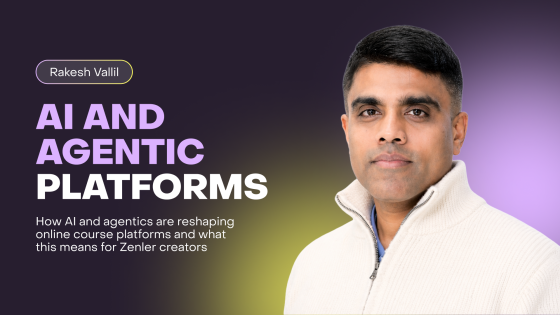
Rakesh explains how AI and agentics are reshaping online course platforms and what this means for Zenler creators.
Online course platforms are entering a new era.
For years, creators mainly needed somewhere to upload lessons, take payments and give students access.
That was enough for a while.
Not anymore.
Today’s creators need more than a simple course delivery tool. They need a connected business system that helps them create, teach, sell, support, automate and grow.
They need courses, memberships, communities, live sessions, email marketing, funnels, student engagement, analytics and smoother workflows.
Now AI is pushing things forward again.
That is why Rakesh’s session, How AI and Agentics Are Changing Online Course Platforms, is such an important part of the Future of AI for Course Creators Summit 2026.
This session matters because AI is not only changing content.
It is changing the platforms creators use to run their entire business.
Quick answer: Rakesh on AI and Agentic Course Platforms explains how to rakesh explains how AI and agentics are reshaping online course platforms and what this means for course creators using Zenler.
Why Online Course Platforms Are Changing
The online course industry has moved a long way from simple video libraries.
Creators no longer want to stitch together ten different tools just to run one business.
They do not want to build a course in one place, send emails from another, host live sessions somewhere else, manage a community on a separate platform and then connect everything together with complicated integrations.
That is exhausting.
And for many creators, it slows everything down.
Modern creators want tools that feel more connected. They want to spend less time fighting tech and more time teaching, supporting students and growing their business.
That is where AI becomes interesting.
AI has the potential to make platforms smarter, more helpful and less dependent on manual admin.
Think again if you believe AI inside a course platform is only about writing lesson titles.
That might be useful, but it is not the big opportunity.
The bigger opportunity is a platform that helps creators move through connected workflows with more support and less friction.
What AI Means for Online Course Platforms
AI inside an online course platform can support many parts of the creator journey.
It can help with course planning, lesson structure, student communication, marketing workflows, content organisation, community support and admin tasks.
For example, a creator building a new course might use AI to turn a rough idea into a course outline.
A membership owner might use AI to organise FAQs and support answers.
A coach might use AI to summarise student questions and identify where people are getting stuck.
A digital business owner might use AI to draft email campaigns, improve onboarding and suggest content ideas based on the offer they are selling.
This is where AI becomes more than a writing assistant.
It becomes part of the operating system of the creator business.
The best version of AI inside a platform should help creators spend less time managing disconnected tasks and more time doing the work that actually matters.
Teaching.
Selling.
Supporting.
Improving the student experience.
Building stronger relationships.
That is the real opportunity.
What Agentic AI Means in Simple Language
Agentics can sound technical.
Let’s make it simple.
Traditional software waits for you to tell it exactly what to do. You click buttons. You fill in fields. You move from screen to screen. You manually connect the pieces.
Agentic AI is different.
It is about AI-powered systems that can understand a goal, use context and help move a workflow forward more intelligently.
For creators, that could mean less manual admin.
Instead of just offering isolated features, a smarter platform could help you complete connected tasks.
It might help you plan a launch, suggest the next step, organise campaign assets, identify gaps in a course, support students, recommend resources or help you manage repetitive workflows.
This does not mean the creator disappears from the process.
You still make the decisions.
You still bring the expertise.
You still check the quality.
But the platform becomes more helpful.
That is an important shift.
Why Agentic AI Matters for Course Creators
Course creators do not usually struggle because they lack ideas.
They struggle because there are too many moving parts.
You need to create the course, write the emails, build the landing page, manage the community, answer questions, run live sessions, track progress, update content and improve the student experience.
That is a lot.
Agentic AI matters because it can help connect these pieces.
Imagine telling your platform that you are preparing to launch a course.
Instead of simply leaving you to build everything manually, the system could help you think through what needs to happen.
It could suggest a course outline, draft an onboarding sequence, organise launch emails, create student support prompts and remind you of missing steps.
Now, this still needs your judgement.
AI should not decide your business strategy for you.
But it can reduce the blank-page problem across your whole platform.
That is powerful.
Especially for solo creators and small teams.
Zenler and the Future of Smarter Creator Workflows
Zenler already supports creators with courses, memberships, communities, live sessions, funnels and email marketing.
That matters because AI becomes more useful when it sits inside connected workflows.
If your course, emails, funnels, community and live sessions are all in separate places, AI has a harder job supporting the full picture.
But when more of your business lives in one connected platform, AI can become more practical.
Rakesh’s session adds a future-focused layer to this conversation.
The question is not simply, “What AI feature comes next?”
The better question is:
How can AI make the creator experience smarter, simpler and more useful?
That is where the future of Zenler becomes exciting.
Creators need platforms that help them manage more without feeling overwhelmed. They need systems that understand how online education, community, content and marketing connect.
AI and agentics can support that future by helping creators automate repetitive work, improve student experience and move faster with less admin.
This is not technology for the sake of technology.
It is about giving creators more space to focus on the work that actually moves their business forward.
AI Course Platforms and the Student Experience
AI course platforms are not just about helping creators.
They can also improve the student experience.
That matters because students do not buy courses just to consume content.
They buy because they want a result.
They want progress. Confidence. Skill. Clarity. Support. A better outcome than they have right now.
A smarter course platform can help students find what they need faster.
It can support onboarding, answer common questions, point students to relevant lessons, summarise resources and help them take the next step.
This connects closely with Gemma Went’s session on AI inside memberships, where the focus is on using AI to support teaching, implementation and retention inside memberships.
The principle is the same.
AI should not make learning colder.
Used well, it can make support feel more available, more organised and more useful.
That is especially valuable in courses and memberships with a lot of content.
Because more content does not automatically create better results.
Clearer guidance does.
AI Can Reduce Admin for Course Creators
Admin is one of the hidden problems in creator businesses.
It does not always look dramatic, but it quietly eats time.
Setting up emails. Updating lessons. Answering repeated questions. Building pages. Creating reminders. Organising resources. Checking student progress. Managing events. Planning content. Sending follow-ups.
It all adds up.
AI can help reduce that load.
Not by replacing the creator, but by supporting the repetitive parts of the business.
For example, AI could help draft student welcome emails, summarise live session notes, create lesson descriptions, suggest follow-up content, organise support answers and turn feedback into improvement ideas.
This connects naturally with David Newton’s session on AI workflow for creators, because both sessions point to the same bigger idea.
AI is most useful when it supports real workflows.
Not random prompts.
Not one-off tricks.
Real business tasks.
That is where creators start to feel the benefit.
AI for Online Course Creation
AI can also support the course creation process itself.
Many creators have strong expertise but struggle to turn that expertise into a clear learning path.
They know their topic too well.
They forget what beginners need first.
They include too much.
They skip important foundations.
They create lessons based on what they want to teach, instead of what the student needs to understand next.
AI can help by acting like a planning partner.
It can help organise a course outline, suggest lesson order, identify missing steps, simplify complex topics and create supporting resources.
Amit Arora’s session on AI for online course creation goes deeper into this practical side of using AI in the online course arena.
Rakesh’s session looks at the platform-level shift.
Together, they show an important point.
AI is not only useful before the course exists.
It can support the full course lifecycle — planning, building, delivery, support, improvement and growth.
What Creators Now Expect from Modern Platforms
Creators have become more demanding, and rightly so.
They want tools that save time.
They want flexible delivery.
They want live learning and community.
They want marketing built in.
They want fewer integrations.
They want better student support.
They want a platform that helps them run the business, not just store the content.
AI raises those expectations even further.
If AI can help draft content, answer questions and organise ideas, creators will naturally expect their platforms to become smarter too.
This is especially true for solo creators and small teams.
They do not have departments.
They need leverage.
A smarter course platform can give creators more ability without forcing them to become tech experts.
That matters because most creators did not start their business because they love backend setup.
They started because they wanted to teach, coach, build a community or share their expertise.
The platform should support that.
The Risk of Adding AI Without Purpose
There is one important warning here.
AI should not be added just because it sounds impressive.
Creators do not need more buttons.
They do not need more features they never use.
They do not need a platform filled with confusing AI tools that create more work.
The goal should be useful assistance.
AI should help creators save time, improve clarity, reduce admin, support students and make better decisions.
If it does not do that, it is just decoration.
This is why Rakesh’s session is important.
It brings the conversation back to purpose.
How can AI and agentics actually improve the creator experience?
How can they make platforms more helpful?
How can they support better course delivery, better workflows and better student outcomes?
Those are the questions that matter.
Why Rakesh’s Session Matters for Zenler Creators
For Zenler creators, this session is especially relevant.
Zenler is already built around the idea that creators need more than a course hosting tool. They need a platform for courses, communities, live sessions, funnels, emails and memberships.
AI adds the next layer.
The future is not just about having more features.
It is about those features becoming more connected and more intelligent.
Rakesh’s session helps creators understand where things are heading and why AI could change the way they build and manage their online education business.
This is not about replacing creators.
It is about supporting them better.
The future of course platforms is not just storage.
It is not just delivery.
It is intelligent assistance around the full creator workflow.
FAQs About AI and Agentic Course Platforms
What is an AI course platform?
An AI course platform is an online course platform that uses artificial intelligence to support tasks such as course planning, content creation, student communication, support, marketing, automation and workflow organisation.
What does agentic AI mean for course creators?
Agentic AI means AI-powered systems that can understand goals, use context and help move workflows forward. For course creators, this could mean smarter support with launches, course setup, student support, content organisation and admin tasks.
Will AI replace online course creators?
No. AI should support course creators, not replace them. Creators still bring the expertise, teaching style, judgement, stories and human connection that students need. AI can help with structure, admin, planning and support.
How can AI improve online courses?
AI can improve online courses by helping creators plan lessons, organise content, answer common student questions, support onboarding, summarise resources and identify where students may need more help.
Why does AI matter for course platforms?
AI matters for course platforms because creators need smarter, more connected systems. AI can reduce manual work, improve workflows and help platforms support the full creator business, not just course delivery.
Is agentic AI useful for small creator businesses?
Yes. Agentic AI can be especially useful for small creator businesses because it can help reduce admin, organise workflows and give creators more leverage without needing a large team.
Final Thoughts
Rakesh’s session is not just about AI features.
It is about the future of how creators build, manage and grow digital education businesses.
Online course platforms are moving beyond storage and delivery.
They are becoming smarter business systems.
For creators, that means more support, better automation and less time lost to admin.
The future of platforms is not just “more buttons”.
It is more intelligent help.
And that is exactly why this session belongs at the heart of the Future of AI for Course Creators Summit 2026.
Want to build, sell and grow your online courses, memberships and communities from one place?
Try Zenler Risk Free for 30 Days and unlock the Accelerator Program that guides you step by step toward success.
https://www.newzenler.com/register
Related platform comparison resources
Use these related guides to compare platforms and plan your creator workflow on New Zenler:
- New Zenler vs Kajabi vs Thinkific comparison
- Migrate to New Zenler without breaking your course business
- New Zenler creator workflow examples
Categories: : AI for Course Creators
Copyright © 2026 Zenler. All rights reserved.
Terms | Privacy Policy | Cookie Policy | Support