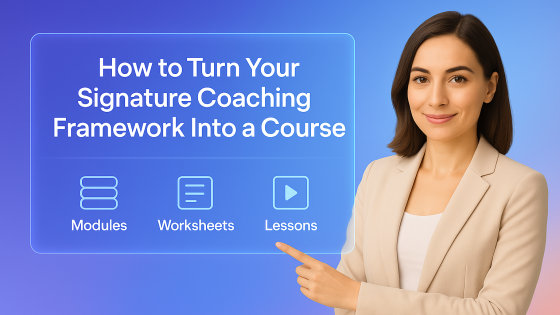
How to Turn Your Signature Coaching Framework Into a Course
 David Zenler
very coach has a signature method — even if you’ve never put it into words before.
Your framework is the unique way you help clients create transformation. It’s the steps, ideas, tools and approaches you use again and again in your coaching sessions. And when you turn that framework into a course, you give people a clear pathway they can follow, at their own pace, with your guidance built in.
A course doesn’t replace coaching. It expands your reach and gives your clients structure, clarity and consistency. It also allows you to scale your impact without adding more hours to your schedule.
And the best part? Turning your coaching framework into a course is far simpler than most coaches expect — especially inside Zenler, where everything is built to support coaches, not overwhelm them.
Let’s walk through the process step by step.
Quick answer: To turn a coaching framework into a course, define the client transformation, break your method into milestones, create lessons around each step, add exercises and accountability, then publish the pathway in Zenler.
Step 1: Define Your Signature Framework Clearly
Every transformation follows a path. You guide clients through a journey — even if it feels intuitive. To build your course, you need to map this path out.
Start by asking:
“What are the stages my clients go through from problem to transformation?”
For example, a classic coaching framework might include:
-
Awareness
-
Mindset
-
Emotional understanding
-
Action
-
Integration
-
Momentum
Your version may be different, but the structure is already there.
Write down the steps you naturally use in your coaching sessions.
Your framework becomes:
-
Your course outline
-
Your module structure
-
Your core teaching path
Once you can see the pathway, everything becomes easier.
Step 2: Break Your Framework Into Modules
Each step of your framework becomes a module inside Zenler.
A good module should focus on one shift, not three or four.
For example:
-
Module 1: Awareness & Clarity
-
Module 2: Understanding Your Inner Voice
-
Module 3: Developing a Growth Mindset
-
Module 4: Action Planning
-
Module 5: Integration & Reflection
-
Module 6: Building Long-Term Momentum
Modules don’t need to be long. They need to be focused.
Your clients want simple, digestible steps that move them forward.
Step 3: Turn Each Module Into Short, Clear Lessons
This is where coaches often overthink. They imagine long videos, scripts, big presentations… but your clients don’t want that.
They want:
-
Clear insights
-
Step-by-step guidance
-
Reflection prompts
-
Bite-sized actions
Inside Zenler, each lesson can be:
-
A short video (3–8 minutes)
-
An audio message
-
A journaling exercise
-
A worksheet
-
A reflection question
-
A simple action step
Your job is not to impress with complexity.
Your job is to guide with clarity.
One lesson = one idea.
That’s how people learn best.
Step 4: Add Practical Tools That Support Transformation
People don’t transform from videos alone. They transform through taking action.
This is why your course should include practical tools, such as:
-
Journaling prompts
-
Printable worksheets
-
Reflection questions
-
Action planners
-
Habit trackers
-
Quick wins
-
Weekly challenges
These tools turn your framework into a lived experience.
Zenler allows you to upload worksheets, PDFs, audio prompts and templates so everything stays organised in one place.
Step 5: Include Touchpoints to Keep Clients Engaged
Even in a self-paced course, you can create a supportive, coaching-style environment.
You can add:
-
Optional live calls
-
Community access
-
Q&A threads
-
Check-in forms
-
Encouragement videos
-
Weekly prompts
These touchpoints turn your course into a hybrid coaching experience — structured yet supported.
A course with touchpoints keeps clients motivated, accountable and connected.
Step 6: Add a Community to Deepen the Outcome
Community is optional, but it's a powerful addition.
People grow faster when they learn together, ask questions, and share wins.
Your community inside Zenler can include:
-
Weekly reflection prompts
-
Accountability posts
-
Wins threads
-
Coaching Q&A
-
Theme discussions
Clients feel held, even inside a self-paced journey.
And community dramatically improves completion rates.
Step 7: Build Your Course Inside Zenler
This is where everything comes together. Zenler makes the process simple:
✔ Create a new course
✔ Add modules based on your framework
✔ Upload your lessons
✔ Add worksheets, audio or reflections
✔ Organise everything into a clear flow
✔ Set access levels
✔ Add your community (optional)
Zenler’s clean course builder keeps everything intuitive. You can publish your course without needing design skills or complex tools.
Step 8: Create a Clear Enrollment Experience
Now that your course is built, people need a simple way to join.
Your course sales page should include:
-
Who the course is for
-
The transformation it leads to
-
What’s included
-
Your framework
-
Expected results
-
Frequently asked questions
-
A clear call to action
Keep it warm, clear and direct — just like your coaching.
Inside Zenler, you can build this page without touching code or hiring a designer.
Step 9: Launch Softly — Then Refine
Launches don’t need to be loud or complicated. You can start gently.
A simple launch looks like:
-
Share your story
-
Introduce the course
-
Explain the transformation
-
Invite your warm audience
-
Support your first cohort
-
Improve the course using their feedback
Your first version doesn’t need to be perfect.
It just needs to be clear and helpful.
This is not an overnight success — but it is a repeatable process.
Step 10: Let Your Course Work for You Long-Term
Once your course is created, you can use it in many ways:
-
As a standalone product
-
As a warm-up for group coaching
-
As a foundation for 1:1 coaching
-
As the core of a membership
-
As support material for your clients
-
As part of a larger transformation program
Your framework is timeless.
Your course becomes the scalable version of your coaching wisdom.
Zenler allows you to keep everything organised and ready to deliver — again and again.
FAQ's
1. Do I need lots of video content to create a coaching course?
No. Short, simple videos work best. You can combine them with audio, worksheets and journaling prompts.
2. How long should my coaching course be?
Most coaching courses include 4–8 modules. The length matters less than the clarity of the transformation.
3. Should I include a community with my course?
It’s optional, but it increases engagement and helps clients stay accountable. Zenler’s built-in community makes this easy.
4. Can I use my coaching framework in multiple offers?
Absolutely. Your framework can power your courses, group programs, memberships and 1:1 coaching.
5. What if my framework isn’t “perfect” yet?
You refine your framework over time. Start with what you already use in sessions. You can evolve it as you coach more clients.
6. Do I need tech skills to build a course in Zenler?
No. Zenler is designed for coaches. If you can upload files and write content, you can build a complete course.
Related Posts for Coaches
Main Post
Related Posts for Coaches
- How Life Coaches Create Transformational Programs
- Turn Your Signature Coaching Framework Into a Course
- How Coaches Use Zenler for 1:1, Group & Courses
- Beginner’s Guide to Selling Your First Coaching Package
- The Simple Funnel Life Coaches Can Build in Under a Day
- Personal Branding for Coaches
- What Every Coach Needs in Their Platform
- How Coaches Use Communities for Engagement
- Complete Guide to Building a Coaching Business on Zenler
- How to Build a Life Coaching Program Online
🎥 Watch the Full Video Series
Prefer to learn by watching? We've turned this entire guide into a step-by-step video series on YouTube.
👉 Watch the Online Coaching Playlist
Related coaching course resources
Use these next guides to turn a coaching framework into a structured course, price it clearly and support students after enrolment.
- Turn your coaching framework into an online course
- Compare simple online course pricing models
- Improve student onboarding after enrolment
FAQ
Who is How to Turn Your Signature Coaching Framework Into a Course for?
How to Turn Your Signature Coaching Framework Into a Course is for online course creators, coaches and educators who want a practical way to build, market and improve their digital learning business with New Zenler.
How does New Zenler support this workflow?
New Zenler combines course delivery, memberships, live sessions, communities, email marketing, funnels, pages, payments and analytics in one connected platform.
What should creators do next after reading this guide?
Creators should choose one improvement to implement, update the related page or campaign, then measure whether it improves leads, engagement, sales or student progress.
Categories: : Online Course Creation
Copyright © 2026 Zenler. All rights reserved.
Terms | Privacy Policy | Cookie Policy | Support