How to Price Your Online Course
 David Zenler
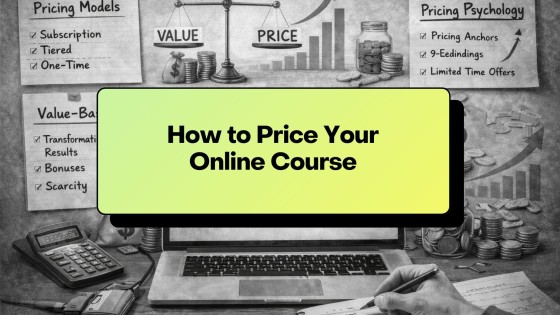
Learn how to price an online course using value, positioning, psychology, offer structure and practical testing rather than guessing.
Pricing your online course is one of the biggest decisions you'll make — and one of the areas creators struggle with the most.
The truth is: There is no single "correct" price. There are strategic prices based on value, positioning, audience, and transformation.
This guide gives you simple pricing frameworks you can use immediately — plus the psychology behind why they work.
Quick answer: what is the best price for an online course?
The best price for an online course depends on the value of the outcome, the depth of support, the audience's urgency, and the offer format. A short self-study course is usually priced lower than a course with coaching, community, templates, certificates, or implementation support.
For most creators, the strongest pricing strategy is to create clear offer tiers: a starter course, a standard course with useful assets, and a premium option with coaching, community access, or feedback. This lets students choose the level of help they need without forcing every buyer into the same package.
🎥 ▶️ How to Price Your Course — Proven Models & Examples
Step 1 — Understand the Value of Your Transformation
People don't pay for videos. They pay for results, shortcuts, and transformation.
Ask yourself:
- What problem does my course solve?
- How much is that problem costing someone right now?
- What is the financial or emotional ROI?
Strong transformations command strong pricing.
🔗 If you haven't structured your full course yet, start here: How to Create an Online Course (Complete Guide)
Step 2 — Use the 3 Core Pricing Models
There are three pricing models used by the top course creators.
Model 1 — Market-Based Pricing Look at similar courses in your niche.
Examples:
- Beginner courses: £30–£99
- Intermediate courses: £99–£299
- Advanced transformation courses: £300–£2,500+
This gives you a benchmark.
Model 2 — Value-Based Pricing Price according to what the student gains.
Examples:
- A "Start Your Jewellery Business" course has a financial ROI → higher price.
- A "How to Use Zoom" mini-course has low ROI → lower price.
Model 3 — Tiered Pricing Offer 2–3 levels:
| Tier | Includes | Price |
|---|---|---|
| Basic | Course only | £49 |
| Standard | Course + templates | £129 |
| Premium | Course + coaching | £299 |
Tiered pricing increases conversions significantly.
Step 3 — Use Pricing Psychology (This Is Where You Win)
These psychological triggers increase perceived value:
1. Charm Pricing Use £97, £197, £297 — these convert higher than rounded numbers.
2. Anchoring Show a higher "compare value" first. Example: "Normally £299 — Launch offer £149".
3. Scarcity & Deadlines Early-bird pricing → massive conversion boosts.
4. Bonuses Add bonuses with real value to increase price justification.
Step 4 — Match Your Pricing to Course Depth
Here's a quick system:
Mini-course (1–2 hours) Price: £19–£59
Core course (3–6 hours) Price: £97–£249
Signature transformation course (6–20+ hours) Price: £299–£2,000
This aligns with market expectations.
🔗 If you want to make sure your plan is solid before pricing, read How to Plan Your Online Course
Step 5 — Offer Early-Bird Pricing to Validate Your Course
Before you record everything, offer a:
- Founders launch
- Pre-sale
- Starter version or limited feature tier
- Early-bird discount
Benefits:
- You validate demand
- You earn money upfront
- You get real user feedback
- You know exactly what to improve
🔗 For full launch steps, see Course Launch Strategy
Step 6 — Decide on One-Time vs Ongoing Pricing
One-Time Payment Perfect for:
- Complete courses
- Beginners
- Clear outcomes
Membership / Subscription Perfect for:
- Ongoing content
- Community
- Coaching
- Templates
- Monthly value
🔗 If you're considering subscriptions, review the Membership Pricing Guide
Step 7 — Add Bonuses That Increase Value Without Increasing Work
The easiest bonuses to add:
- Templates
- Cheat sheets
- Example files
- Extra mini-lesson
- Q&A session
- Community access
These increase perceived value far more than they increase your workload.
Step 8 — Test and Adjust
Your first price is not your final price.
You can adjust based on:
- Conversion rate
- Refund rate
- Market demand
- Traffic quality
- Feedback
Most creators increase their price over time as value increases.
🎯 Pricing Checklist
- Your transformation is clear
- Your level (mini / core / signature) is chosen
- You've benchmarked your market
- You've chosen a pricing model
- You've added bonuses
- You've planned your launch pricing
You're ready to set your price and start selling.
❓ FAQ's
Q: What is the best price for a beginner course? Typically £19–£99 depending on depth and transformation.
Q: Should I do monthly or one-time pricing? One-time pricing works better for standalone courses. Monthly pricing works best for memberships or coaching.
Q: Should I offer discounts? Yes — but strategically. Use early-bird or limited-time pricing for launches.
Q: How do I know if my price is too low or too high? Test → review performance → adjust. Pricing is flexible.
🚀 Call to Action
Once you've priced your course, it's time to upload your lessons and prepare for launch.
Zenler gives you everything you need — course hosting, funnels, payments, email sequences, and more.
👉 Start building and selling today with Zenler
📌 Your Complete Course Creation Roadmap
How to Create an Online Course (Complete 2026 Step-by-Step Guide)
- How to Plan an Online Course
- How to Script / Outline Your Course
- How to Record an Online Course
- Course Equipment Guide
- How to Price Your Online Course
- How to Upload & Structure a Course in Zenler
🎥 Watch the Full Video Series
Prefer to learn by watching? We've turned this entire guide into a step-by-step video series on YouTube.
👉 Watch the Course Creation Playlist
How should course creators choose between one-time pricing and payment plans?
Use one-time pricing when the course is affordable, easy to understand, and delivers a clear standalone outcome. Use payment plans when the transformation is deeper, the price is higher, or students need a more accessible way to start. If you use New Zenler, keep the offer simple and make the checkout page explain exactly what the student gets at each level.
What should you include in a higher-priced course offer?
A higher-priced course should include more than extra videos. Add value through live sessions, templates, feedback, implementation checklists, a private community, certificates, or direct coaching. The goal is to increase the likelihood that students complete the course and get the promised result.
Related New Zenler pricing resources
For deeper pricing strategy, read The Art and Science of Online Course Pricing, Pricing Psychology for Creators, and Upsells, Downsells and Bundles for Creators. To check current platform options, use the official New Zenler pricing page as the source of truth.
Related pricing and offer resources
Use these next guides to connect pricing decisions with course format, membership models and post-launch performance.
- Compare simple online course pricing models
- Choose between a course and membership site
- Track online course analytics after launch
FAQ
How should I price my online course?
Price your course by considering the learner outcome, audience, support level, transformation value, market alternatives and your positioning.
What pricing mistakes should course creators avoid?
Avoid pricing only by course length, copying competitors blindly, discounting too quickly or ignoring the value of support and outcomes.
Can creators test course pricing?
Yes. Creators can test pricing with waitlists, early offers, audience conversations, cohorts and measured launch feedback.
Categories: : Course Pricing
Copyright © 2026 Zenler. All rights reserved.
Terms | Privacy Policy | Cookie Policy | Support