Stephany Oliveros On Human-Centred AI For Creators
 David Zenler
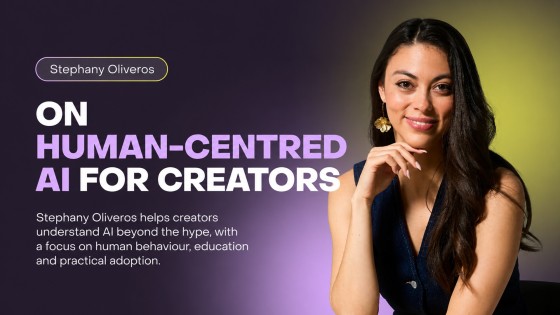
Stephany Oliveros helps creators understand AI beyond the hype, with a focus on human behaviour, education and practical adoption.
Stephany Oliveros helps creators understand AI beyond the hype, with a focus on human behaviour, education and practical adoption.
AI is not just a technology shift.
It is a behaviour shift.
And that is where many course creators, coaches and digital business owners need to pay closer attention.
Because the real question is not just, “Which AI tool should I use?”
The better question is:
“How is AI changing the way people learn, decide, create and trust?”
That is why Stephany Oliveros is such an important speaker at the Future of AI for Course Creators Summit 2026.
Stephany is the co-founder of SheAI and works at the intersection of AI, education, psychology and human behaviour. SheAI describes her as CEO and co-founder, with experience as a founder in product development and marketing.
She has also been described as an AI product manager, psychologist and co-founder of SheAI, an educational platform backed by the United Nations for female AI literacy.
That combination matters.
Because AI adoption is not only about software.
It is about people.
Save your place for the Summit here: zenler.co/AI-Summit-Link
Quick answer: Stephany Oliveros On Human-Centred AI For Creators explains how to stephany Oliveros helps creators understand AI beyond the hype, with a focus on human behaviour, education and practical adoption.
Why Stephany Oliveros Matters For Course Creators
A lot of AI conversations are too tool-focused.
Use this app.
Try this prompt.
Build this automation.
Watch this workflow.
That can be helpful, but only up to a point.
The problem is, course creators are not just trying to use AI for themselves. They are often teaching, guiding or supporting other people too.
That means they need to understand AI in a deeper way.
How do people learn with AI?
How do students build confidence with new technology?
How do you stop AI from making people more passive?
How do you use AI without losing the human side of teaching?
Stephany’s work connects directly with these questions.
Her background includes AI education, human behaviour and ethical technology. She has spoken about using AI in ways that enhance human storytelling rather than replace it, and has been described as a founder of SheAI, an educational platform helping women navigate AI confidently.
For course creators, that is a big lesson.
AI is not just about speed.
It is about confidence, judgement and better learning experiences.
AI Literacy Is Now A Creator Skill
AI literacy simply means understanding how to use AI well.
Not perfectly.
Not technically.
Well.
For course creators, AI literacy means knowing what AI can do, where it struggles, when to trust it, when to question it and how to use it without weakening your own voice.
That last part is important.
Because many creators are already using AI to write content, create lessons, draft emails and summarise ideas.
But some of that work is starting to sound the same.
Same tone.
Same structure.
Same phrases.
Same polished-but-empty feel.
Think again if you believe your audience will not notice.
They may not say, “This sounds AI-generated.”
But they will feel something is missing.
Your voice.
Your judgement.
Your lived experience.
Your way of explaining things.
That is why human-centred AI matters.
AI should support your thinking, not flatten it.
The Problem With AI Hype
There is a lot of noise around AI.
Some people make it sound like you need to automate everything immediately.
Others make it sound like every creator needs agents, complex workflows and advanced systems.
But Stephany has publicly pushed back against the idea that everyone needs expensive AI agent and automation courses, saying much of the free content around workflows and tutorials can become noise disguised as education.
That is a useful warning.
Because course creators can easily get pulled into learning more and more without actually improving the business.
Watching tutorials can feel productive.
Building workflows can feel productive.
Trying tools can feel productive.
But if none of it helps your students, improves your offer, saves meaningful time or supports better decisions, then it may just be another distraction.
This is where AI literacy becomes practical.
You need to know enough to choose wisely.
Not chase everything.
Human-Centred AI Starts With The Learner
If you teach online, your job is not just to deliver information.
Your job is to help people move.
From stuck to clear.
From unsure to confident.
From overwhelmed to focused.
From learning to implementation.
AI can help with this, but only when it is designed around the learner.
For example, AI could help a student understand a lesson in simpler language.
It could help them reflect on what they have learned.
It could help them choose the next step.
It could help them apply your framework to their own situation.
It could help them get unstuck between live calls.
This connects closely with Gemma Went’s session on using AI inside memberships, where AI becomes a support layer for members rather than a replacement for the creator.
But there is a warning here too.
If AI gives too much of the answer too quickly, students may stop thinking.
And if students stop thinking, they stop learning properly.
So the creator’s role becomes even more important.
You need to design the experience.
You need to decide where AI helps, where it guides and where the student still needs to do the work.
AI Should Not Replace Your Judgement
This is one of the biggest points for course creators.
AI can help you create faster.
But faster is not always better.
AI can write a lesson outline, but it does not know your students like you do.
AI can suggest email copy, but it does not fully understand your relationship with your audience.
AI can summarise a topic, but it cannot replace your lived experience.
AI can give feedback, but it may miss the emotional or human context.
So use it.
But do not hand over your judgement.
That is where many creators go wrong.
They treat AI output as finished.
It rarely is.
A better approach is to use AI as a thinking partner.
Ask it to challenge your assumptions.
Ask it to find gaps.
Ask it to simplify your explanation.
Ask it to create options.
Then you decide.
That is the difference between using AI and being led by AI.
Where Stephany’s Session Fits Into The Summit
The Future of AI for Course Creators Summit 2026 brings together different voices across AI, marketing, SEO, platforms, memberships and creator business growth.
Each session looks at a different part of the AI shift.
Neil Patel’s AI SEO session for course creators focuses on visibility and how creators can adapt as search changes.
Rakesh’s session on agentic AI inside online course platforms looks at how AI agents may shape the future of learning platforms.
Mike Samuels’ session on AI sales copy and human voice explores how creators can use AI for copy without losing personality.
Joel Erway’s session on AI ad creation focuses on using AI to create and test stronger ads.
David Newton’s session on AI for creators looks at the wider AI opportunity for online business owners.
Noelle Russell’s session on AI leadership for course creators brings in the bigger picture of AI strategy, responsibility and business growth.
Stephany Oliveros adds another important layer.
Human-centred AI.
How do we use AI in a way that helps people learn, create and grow without losing themselves in the process?
That is a conversation every creator needs to have.
Why AI Education Needs More Human Voices
One of the most interesting parts of Stephany’s work is her focus on helping more women and diverse voices take part in AI.
This matters because AI is not neutral in how it gets adopted.
The people who understand it early often shape how it gets used.
The people who feel excluded from it can be left behind.
For course creators, coaches and educators, this creates a responsibility.
You may be someone else’s first trusted guide into AI.
That means your explanation matters.
Your tone matters.
Your examples matter.
Your ethics matter.
If you make AI feel intimidating, people may avoid it.
If you make it sound magical, people may misuse it.
If you make it practical, human and understandable, people can start using it with confidence.
That is a powerful role to play.
A Simple Way Course Creators Can Use AI More Humanly
Here is a useful exercise.
Before using AI in your course business, ask three questions:
- Does this help my audience understand something better?
- Does this save time without reducing trust?
- Does this keep human judgement involved?
If the answer is yes, AI may be useful.
If the answer is no, pause.
This is simple to do.
For example, using AI to summarise a long lesson into a quick recap could help students.
Using AI to create reflection prompts after a module could help students think more deeply.
Using AI to draft a first version of an email could save time.
But using AI to mass-produce generic content that does not sound like you?
That may weaken your brand.
Remember, the goal is not to look more automated.
The goal is to become more useful.
AI Adoption Is About Confidence, Not Just Skill
A lot of people feel behind with AI.
They see others building workflows, launching tools and talking about agents.
Then they feel like they are late.
But many people are not behind.
They are overwhelmed.
There is a difference.
AI adoption works better when people build confidence step by step.
Start with one use case.
Learn it properly.
Apply it to a real problem.
Review the output.
Improve it.
Then move to the next use case.
That is much better than trying ten tools and mastering none of them.
For course creators, this is also a useful way to teach AI to students.
Do not overwhelm people with everything AI can do.
Show them what matters first.
What Course Creators Should Take From Stephany’s Work
The biggest takeaway is this:
AI should make you more human, not less.
It should help you explain better.
It should help you support better.
It should help you think better.
It should help your students make progress with more confidence.
But it should not replace your voice, your values or your responsibility as a creator.
That is where Stephany Oliveros’ perspective is so valuable.
She is not just looking at AI as a tool.
She is looking at how AI interacts with people.
And in education, that is everything.
Join Stephany Oliveros At The Future Of AI For Course Creators Summit 2026
Stephany Oliveros will be speaking at the Future of AI for Course Creators Summit 2026.
If you are a course creator, coach, membership owner or digital business owner, this is a session worth paying attention to.
Because AI is not only changing how we create.
It is changing how people learn, trust, decide and take action.
And the creators who understand that will be in a much stronger position.
Save your place for the Summit here: zenler.co/AI-Summit-Link
Related AI workflow resources
Use these Zenler guides to connect AI ideas with practical course business workflows:
- How course creators can use AI agents without losing their brand voice
- AI course launch checklist for New Zenler creators
- AI agents for course creators: practical workflows and examples
FAQ
Who is Stephany Oliveros?
Stephany Oliveros is the co-founder of SheAI and works across AI education, psychology, product and human behaviour. SheAI lists her as CEO and co-founder, with experience in product development and marketing.
What is SheAI?
SheAI is an educational platform focused on helping women become more confident and prepared for AI. Stephany has been described as a co-founder of SheAI, with the platform connected to female AI literacy and education.
Why should course creators care about human-centred AI?
Course creators should care because AI affects how people learn, create and make decisions. Human-centred AI helps creators use technology without losing trust, voice or the personal support that makes online learning work.
How can creators use AI without losing their voice?
Use AI as a draft partner, not the final writer. Add your examples, opinions, phrases, stories and judgement before publishing anything. Your audience should still feel like they are learning from you.
Is AI literacy important for online educators?
Yes. AI literacy helps online educators understand what AI can do, where it can go wrong and how to use it responsibly. This matters because creators are often guiding students, clients or members through change.
Where can I register for the Future of AI for Course Creators Summit 2026?
You can save your place for the Future of AI for Course Creators Summit 2026 here: zenler.co/AI-Summit-Link
Categories: : AI for Course Creators
Copyright © 2026 Zenler. All rights reserved.
Terms | Privacy Policy | Cookie Policy | Support