Teach Only What Students Need To Succeed
 David Zenler
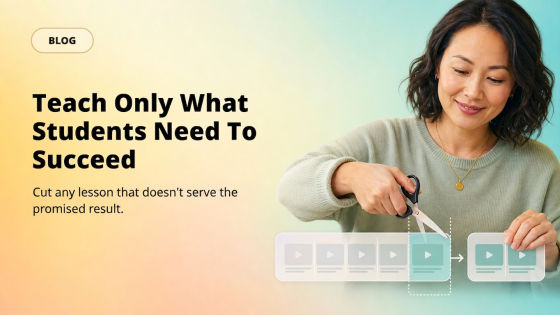
Too many lessons can slow students down. Learn how course creators can trim content and keep only what helps learners succeed.
The Short Answer
Remove Unnecessary Lessons is a useful reminder because the real lesson is this: teach only what students need to succeed. That sounds simple, but it can change how you build, package and sell your course.
A useful course is not a container for everything you know. It is a guided path to a result your student cares about.
A photography teacher may know fifty editing techniques, but a beginner course might only need five. The extra techniques can become bonuses, emails or an advanced course later.
Why This Matters For Course Creators
Course creators often lose time by building around what looks impressive instead of what helps the learner move. More lessons, more production, more clever positioning and more features can all feel productive. But if the student cannot see the result, trust the path or complete the next action, the extra work does not help.
The problem is not ambition. It is direction. A good online course is not a warehouse of knowledge. It is a guided route from a real problem to a useful result. When you build with that in mind, your content becomes easier to finish, easier to sell and easier for students to recommend.
If this is the stage you are working on, you may also find Interactive Learning: How To Make Your Online Courses More Engaging and Course Creators Pitfalls useful because they connect this tip to a practical next step.
What To Do Before You Build More
Before adding another lesson, recording another video or rewriting the whole offer, pause and ask one practical question: what does the learner need next? Not what could you teach. Not what would make the course look bigger. What do they need next to make progress?
That one question removes a surprising amount of noise. It helps you trim unnecessary content, explain the outcome more clearly and create a course that feels lighter without feeling thin.
How To Apply This Tip This Week
- Write the learner's desired result in one plain sentence.
- List the smallest useful action that proves progress.
- Remove or move anything that does not support that result.
- Add one example from real students, clients or your own work.
- Tell the learner exactly what to do after the lesson.
This is simple to do. The point is not to make the course smaller for the sake of it. The point is to make the path clearer, so students know why each lesson exists.
What Good Looks Like
A strong course tip should create a visible change in behaviour. The learner should know what to do, why it matters and how to tell whether they have done it well enough. That does not require a complicated framework. It requires clear teaching and a practical checkpoint.
For example, a lesson can end with a short task, a quick decision, a simple draft, a checklist item or a small result they can see. These early proof points build confidence. They also reduce refund risk because the student feels momentum before motivation drops.
How This Helps Your Sales Page
This tip also makes your sales page easier to write. When the course result is clear, your headline, bullet points, lesson descriptions and call to action all have a stronger centre. You stop trying to impress people with quantity and start helping them understand the change they can expect.
A buyer is usually asking a very human question: will this help me with the thing I am struggling with? If your page answers that quickly, the decision feels safer. If your page lists everything you know, the buyer has to do too much work to understand the value.
How This Helps Students Finish
Clear course design is not only about selling. It also helps students finish. When each lesson has a purpose and each task is connected to the bigger result, learners do not have to guess why they are doing the work.
That matters because online students are often busy. They may be learning between client calls, family responsibilities or a full-time job. The clearer you make the path, the less energy they waste deciding what matters. This is where good teaching starts to feel supportive instead of overwhelming.
A Quick Self-Audit
- Can a new student explain the result in one sentence?
- Does each lesson support that result directly?
- Is there an early win before the course becomes demanding?
- Are examples specific enough to feel real?
- Does the next action feel obvious at the end of each lesson?
If two or more answers are no, do not panic. That is simply your next improvement list. Tighten the promise, trim the lesson path and add one useful example at a time.
Common Mistakes To Avoid
Adding Content To Prove Value
More content can make a course feel heavier, not better. Add content only when it helps the learner achieve the promised result.
Hiding The Outcome
If people cannot explain what your course helps them do, they will struggle to buy it. Make the outcome clear on the sales page, in the first lesson and throughout the course.
Ignoring Real Learner Signals
Student questions, drop-off points, support requests and sales objections are useful data. Use them. They show you where the course needs more clarity.
A Simple Example
Imagine a creator teaching people how to build a lead magnet. The weak version has eight broad lessons, each covering a different marketing theory. The stronger version gets the student to choose one audience, name one problem, create one useful asset and publish one opt-in page. The second course may have fewer lessons, but it creates a clearer result.
Remember, students do not judge a course only by how much information it contains. They judge it by whether it helps them move. That is why clarity, action and proof matter so much.
FAQ
How does "Remove Unnecessary Lessons" help course creators?
It helps course creators focus on the learner's next useful result. That makes the course clearer, easier to finish and easier to explain to buyers.
Should I make my course shorter?
Not automatically. Make it as long as it needs to be and no longer. Remove lessons that distract from the promised outcome.
How do I know if students need more support?
Look for repeated questions, low completion points, unclear assignments and places where students stop taking action. These signals show where support or examples may be missing.
Can I use AI to help with this?
Yes, AI can help outline lessons, draft examples and organise feedback. Your judgement should still decide what stays, what goes and what proof the learner needs.
Related Posts
- Interactive Learning: How To Make Your Online Courses More Engaging
- Course Creators Pitfalls
- How To Create Your First Online Course With Zenler
- How To Create A Mini Course From Scratch In 3 Simple Steps
Your Next Step
Choose one course, lesson or offer and make the next action clearer today. Keep your eyes open for where students hesitate. That hesitation is often the best place to improve the course.
Ready to package your expertise and sell with more confidence? Try Zenler risk free for 30 days
Categories: : Online Course Creation
Copyright © 2026 Zenler. All rights reserved.
Terms | Privacy Policy | Cookie Policy | Support