AI Virtual Assistant for Small Business
 David Zenler
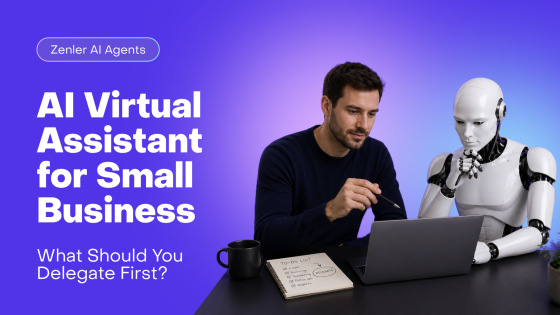
Learn how an AI virtual assistant can help small businesses with scheduling, email drafting, support, research and content planning.
If you've ever reached the end of the day and wondered, "What did I actually achieve today?" you're not alone.
Running a business often feels like spending your day putting out fires. Replying to emails. Booking meetings. Updating spreadsheets. Planning social media. Answering customer questions.
By the time you've finished all the little jobs, there's very little time left for the work that actually grows your business.
That's where an AI virtual assistant comes in. Not to replace you. Not to replace your team. But to take care of the repetitive tasks that quietly steal hours every week.
Quick answer: An AI virtual assistant helps small businesses automate everyday tasks such as scheduling, email drafting, customer support, research, and content planning so owners can spend less time on administration and more time on higher-value work.
What Is An AI Virtual Assistant?
Think of an AI virtual assistant as a digital team member. Unlike a traditional virtual assistant, it doesn't need training on every individual task.
Instead, it uses artificial intelligence to understand requests, organise information and complete routine jobs much faster than manual methods. It isn't human. But it can remove a surprising amount of repetitive work.
The Hidden Cost Of Small Tasks
Here's something most business owners underestimate. Small jobs don't look expensive.
Five minutes replying to an email. Ten minutes organising a calendar. Another fifteen minutes searching for a document. None of those feel significant.
But together? They can easily consume ten or fifteen hours every week. That's almost two working days. Imagine getting those days back.
What Should You Delegate First?
One mistake people make is trying to automate everything immediately. Instead, start with the jobs that don't need your expertise. For example:
- Managing your calendar
- Drafting routine emails
- Summarising meetings
- Organising notes
- Creating task lists
- Planning content
- Researching ideas
- Answering common questions
These jobs follow predictable patterns. They're exactly where AI performs well.
AI Doesn't Replace Decision Making
This is an important distinction. AI can organise information. It can suggest options. It can draft replies.
What it shouldn't do is make important business decisions without your input. You're still responsible for:
- Strategy
- Relationships
- Pricing
- Coaching
- Customer experience
- Business direction
Think of AI as preparing the information you need so you can make better decisions faster.
A Day With An AI Assistant
Imagine starting your morning. Instead of opening a cluttered inbox, your AI assistant has already:
- Prioritised your emails
- Summarised important conversations
- Highlighted urgent tasks
- Suggested replies
- Organised today's schedule
- Reminded you about follow-ups
Before you've had your first coffee, much of your administrative work is already organised. That's a very different way to begin the day.
AI Virtual Assistants For Course Creators
Course creators have another advantage. Much of their work follows repeatable processes.
Launching a course. Welcoming students. Scheduling webinars. Publishing blogs. Updating communities. Sending emails.
An AI assistant can help coordinate many of these tasks while allowing you to focus on creating great learning experiences.
AI Works Best Alongside Other AI Tools
A virtual assistant becomes even more valuable when it connects with the rest of your business. For example, it could remind you that it's time to publish a blog. Then ask your AI social media assistant to create promotional posts. Then ask your AI email assistant to draft a newsletter. Then notify your customer support assistant about expected enquiries.
That's where AI starts behaving less like software and more like a small team.
Your AI Coworker
Personally, I think this is one of the most exciting shifts we're seeing. We're moving away from AI being "a chatbot." Instead, it's becoming a collection of digital coworkers, each responsible for different parts of your business.
If that idea interests you, you'll enjoy reading Meet Your AI Coworker. It explores how AI assistants are beginning to work together rather than operating in isolation.
Zenler And AI Productivity
Imagine running your courses, emails, blog, funnels, memberships and communities from one platform. Now imagine AI helping with each of those areas.
That's where real productivity gains begin. You're no longer juggling disconnected tools. Everything works together.
Don't Try To Automate Everything
Here's one final piece of advice. Start small. Choose one repetitive task. Automate it. Measure the time you save. Then automate the next one.
Businesses rarely become dramatically more productive overnight. They improve through dozens of small changes that gradually transform the way they work.
Related Posts
Continue learning with these guides:
- AI Social Media Manager
- Meet Your AI Coworker
- AI Agents for Small Business
- AI Agents for Marketing
- AI for Solopreneurs
Frequently Asked Questions
What is an AI virtual assistant?
An AI virtual assistant is software that helps automate everyday business tasks such as scheduling, email drafting, research, note-taking and customer support.
Can AI replace a human virtual assistant?
AI can automate many repetitive administrative tasks, but human assistants remain valuable for complex communication, relationship management and business judgement.
Is an AI virtual assistant worth it for small businesses?
For many businesses, yes. Even saving a few hours every week allows owners to spend more time serving customers and developing new opportunities.
What tasks should I automate first?
Start with repetitive administrative work such as email organisation, calendar management, meeting summaries and content planning before moving to more advanced workflows.
Do AI virtual assistants need technical knowledge?
Most modern AI assistants are designed to be easy to use and require very little technical expertise to get started.
What To Do Next
Don't think about replacing yourself. Think about removing the jobs that stop you doing your best work.
Let AI handle the routine administration. Use the time you've gained to teach, coach, create and build stronger relationships with your audience.
After all, that's the part of your business no AI can ever replace.
Related productivity guide: AI productivity for entrepreneurs and course creators.
Related AI workflow resources
Use these Zenler guides to connect AI ideas with practical course business workflows:
- How course creators can use AI agents without losing their brand voice
- AI course launch checklist for New Zenler creators
- AI agents for course creators: practical workflows and examples
Categories: : AI for Course Creators
Copyright © 2026 Zenler. All rights reserved.
Terms | Privacy Policy | Cookie Policy | Support