Best Course Landing Page Structure: A New Zenler Page Builder Example
 David Zenler
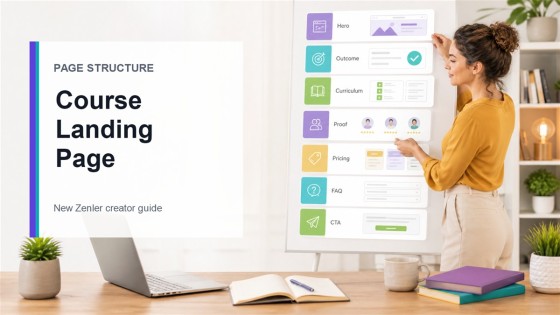
Learn the best course landing page structure for creators, with a practical New Zenler page builder example covering hero, proof, curriculum, FAQs and CTA.
Quick answer: The best course landing page structure starts with a clear outcome, explains who the course is for, shows the curriculum, proves why the creator can help, answers objections, presents pricing clearly and repeats one call to action. In New Zenler, you can build this with page builder blocks, connect it to checkout, and track the funnel path.
A course landing page has one job: help the right person decide whether your course is the next step.
It does not need to be clever. It needs to be clear.
For a broader conversion checklist, pair this page structure with the landing page best practices for creators guide.
The Best Course Landing Page Structure
Use this order as your starting point:
- Hero with outcome and CTA.
- Problem and promise.
- Who the course is for.
- What students will learn.
- Curriculum or module breakdown.
- Why this method works.
- Instructor credibility.
- Proof, testimonials or examples.
- What is included.
- Pricing and guarantee.
- FAQ and objection handling.
- Final CTA.
This structure works because it follows the buyer’s questions in order: What is this? Is it for me? Can it help? What do I get? Can I trust you? What happens next?
1. Hero: Outcome, Audience and CTA
The hero section should answer the main question immediately.
Include:
- A headline focused on the result.
- A short subheadline explaining who it is for.
- A course image, instructor image or useful visual.
- One primary CTA button.
- A trust cue, such as format, start date, access or support.
Example headline: “Build Your First Profitable Online Course in 30 Days.”
Example CTA: “Join the Course.”
2. Problem and Promise
Show that you understand the problem before explaining the course.
Keep this practical. Describe what the learner is struggling with and what will change after they follow the course process.
Good course pages do not just list lessons. They connect lessons to a desired result.
3. Who the Course Is For
This section helps visitors qualify themselves.
Use bullets such as:
- You are a coach with a repeatable framework.
- You want to turn expertise into lessons.
- You need a clear sales page and launch path.
- You want practical implementation, not theory.
This also reduces refunds and poor-fit buyers because the page is honest about who should join.
4. What Students Will Learn
Summarise the course outcomes before the detailed curriculum.
Use benefits, not just topics:
- Plan a course outcome people understand.
- Structure modules in the right order.
- Create lessons that support action.
- Build a sales page and checkout path.
- Launch with email and funnel follow-up.
5. Curriculum or Module Breakdown
Now show the structure.
Each module should have a name and a short outcome. Avoid long lists of every tiny lesson unless the detail helps people buy.
The current New Zenler online course platform page is the best source-of-truth page for current course-building capability.
6. Why This Method Works
This section explains your approach.
For a business course, show the framework. For a skill course, show the progression. For a coaching course, show how your method takes someone from problem to result.
If your offer includes a funnel, connect it to the complete New Zenler course funnel tutorial.
7. Instructor Credibility
People want to know why they should learn from you.
Include relevant experience, examples, teaching background, client work, results you can support, or the reason you created the course.
Avoid vague claims. Specific, believable credibility is stronger.
8. Proof, Testimonials or Examples
Use proof where you have it.
That could include testimonials, student work, before-and-after examples, screenshots, case studies, reviews or stories. If you do not have testimonials yet, use clear examples and explain the process honestly.
9. What Is Included
List the assets clearly:
- Course modules.
- Downloadable resources.
- Templates.
- Community access.
- Live sessions.
- Replay access.
- Certificates, if relevant.
- Bonuses.
10. Pricing and Checkout
Pricing should be simple to understand.
Show what the learner gets, the payment options, and the CTA. For pricing strategy, read How to Price an Online Course.
In New Zenler, course pages can connect into funnels, checkout and payment options. Use the current sales funnel software and landing page builder pages as source-of-truth references.
11. FAQ and Objection Handling
Answer the questions that stop people from buying:
- How long do I get access?
- Is this beginner friendly?
- How much time do I need?
- Is there live support?
- What if I fall behind?
- Can I pay in instalments?
Good FAQs help real buyers make a decision. They also make the page easier for search and AI systems to understand.
12. Final CTA
End with one clear action.
Repeat the outcome, remind them what is included, and ask them to join, enrol, apply or start.
How to Build This in New Zenler
Use this simple build path:
- Create or open your course.
- Open the course page or landing page builder.
- Add hero, benefits, curriculum, proof, pricing and FAQ blocks.
- Connect the CTA to checkout, registration or your funnel step.
- Add SEO title, meta description, URL and social image.
- Connect follow-up emails or automations if the page is part of a funnel.
- Review analytics after traffic starts coming in.
The current New Zenler website builder page also confirms SEO controls, tracking code areas, custom domains and connected products.
Where This Fits in Your Funnel
A course landing page usually sits after a blog post, lead magnet, webinar, email sequence or sales call.
For the top of the funnel, use 25 Lead Magnet Ideas for Course Creators. For the full funnel structure, use How to Build a Sales Funnel for Creators.
Conclusion
The best course landing page structure is clear, sequential and focused on one decision.
Start with the outcome. Show who it is for. Explain the method. Prove credibility. Make the offer easy to understand. Answer objections. Give one clear CTA.
Then use New Zenler’s page builder, funnel tools, checkout, automations and analytics to improve it from real visitor behaviour.
FAQ
What should a course landing page include?
A course landing page should include a clear outcome, audience fit, benefits, curriculum, proof, instructor credibility, pricing, FAQs and one strong call to action.
How long should a course landing page be?
It should be long enough to answer the buyer’s real questions. A simple course may need a short page, while a premium course may need more proof, curriculum detail and FAQs.
Can I build course landing pages in New Zenler?
Yes. New Zenler includes a drag-and-drop page builder, landing pages, funnels, checkout, SEO controls and tracking options for course creators.
Should my course landing page have one CTA?
Yes. The page can repeat the CTA in multiple places, but the action should stay focused: enrol, join, register, apply or start.
Categories: : Website Builder
Copyright © 2026 Zenler. All rights reserved.
Terms | Privacy Policy | Cookie Policy | Support