How to Turn a Coaching Framework Into a Sellable Online Course
 David Zenler
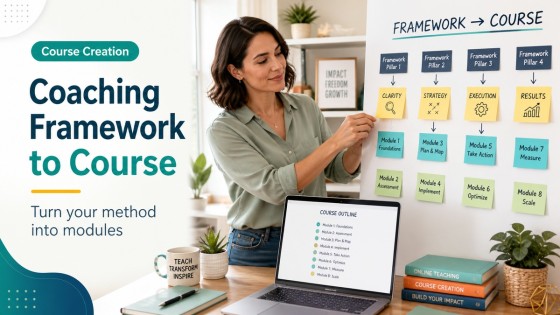
Learn how to turn a coaching framework into a sellable online course with clear outcomes, modules, lessons, worksheets, community and launch steps.
Quick answer: To turn a coaching framework into a sellable online course, define the client transformation, break your framework into stages, turn each stage into modules and lessons, add worksheets or action steps, decide where live coaching or community support belongs, build the course in New Zenler, then launch it with a simple page, lead magnet, emails and a clear checkout path.
If you are a coach, you probably already have more course material than you think.
Your framework may not be sitting in a polished slide deck yet, but it shows up every time you help a client move from confusion to clarity. It is in your intake questions, your session notes, your exercises, your repeat phrases, your homework, your check-ins and the way you diagnose what needs to happen next.
The job is not to invent a course from scratch. The job is to make your coaching process teachable, repeatable and easy for a student to follow.
Start With the Transformation, Not the Content
A sellable course starts with a clear result. Before you outline modules, define the before-and-after journey your framework creates.
Write one simple sentence:
This course helps [specific learner] go from [current problem] to [desired outcome] without [common obstacle].
For example:
- This course helps new coaches turn scattered ideas into a structured signature offer without spending months building content.
- This course helps yoga teachers create a beginner program without needing a complicated tech setup.
- This course helps consultants productize their client process without losing the personal value of their expertise.
That transformation becomes the anchor for your course title, sales page, lessons, worksheets and email copy.
Map Your Coaching Framework Into Stages
Most coaching frameworks have a natural order. Your clients usually need awareness before action. They need a plan before accountability. They need foundations before advanced implementation.
Take your framework and list the major stages a client moves through. These stages usually become your course modules.
A simple structure might look like this:
- Diagnose the starting point.
- Set the goal and success criteria.
- Build the core plan.
- Take the first implementation steps.
- Review results and improve.
- Create the next-level habit or system.
This keeps the course outcome-led rather than content-heavy. It also helps learners understand where they are in the journey.
If you want a broader coaching-business view, this pairs well with the New Zenler guide to building your coaching business online and the practical guide on building a life coaching program.
Turn Each Stage Into Lessons
Once you have modules, turn each stage into a small set of focused lessons.
For each lesson, answer four questions:
- What does the learner need to understand?
- What action should they take?
- What resource would make that action easier?
- How will they know they have completed the step?
A course lesson should not simply be a recording of everything you know. It should help the learner take one meaningful step.
In New Zenler, you can build the course as sections and lessons, add videos, downloads, quizzes, preview settings, drip schedules and other learning assets from the course area. The online course platform page gives the current source-of-truth view of the course-building features.
Decide What Becomes Self-Study and What Stays Live
Not every part of your coaching needs to become a video lesson.
Some parts are best as self-study:
- Foundational explanations
- Repeatable teaching points
- Templates and worksheets
- Step-by-step setup tasks
- Frequently repeated coaching advice
Other parts may work better as live or community support:
- Personal feedback
- Mindset blocks
- Accountability check-ins
- Group Q&A
- Implementation reviews
This is where a coaching course can become stronger than a simple video library. You can package the repeatable teaching into lessons, then keep the human coaching where it adds the most value.
Zenler supports this type of blended experience with courses, coaching, live sessions and community tools in one platform. For community-led support, see the current online community platform feature page.
Create Worksheets From Your Coaching Questions
Your best worksheets are probably already hidden in your coaching questions.
Look at the questions you ask clients again and again:
- What do you want to change?
- What have you already tried?
- What is the real blocker?
- What would success look like in 30 days?
- What action can you take this week?
Turn those questions into downloads, checklists, reflection prompts or implementation templates. These resources help learners apply the lesson rather than passively watch it.
A useful pattern is: teach the concept, show an example, then give the learner a worksheet or task that moves them forward.
Build a Simple Course Structure in New Zenler
When the framework is mapped, build the first clean version of the course. Keep it practical and manageable.
A strong first version might include:
- One welcome lesson that explains the outcome and how to use the course.
- Four to six core modules based on your coaching framework.
- Two to five lessons per module.
- One action step or worksheet per module.
- A final review lesson that helps learners measure progress and decide the next step.
You can then improve the course based on learner questions, completion data, feedback and sales conversations.
For a beginner-friendly walkthrough, link this process with How to Create Your First Online Course with New Zenler.
Create the Sales Path Around the Course
A course is not sellable just because the lessons are finished. Learners also need to understand the problem, the promise, the outcome and why your framework is the right path.
Build a simple sales path:
- A lead magnet or useful blog post that attracts the right audience.
- A landing page that explains the course outcome.
- A checkout path with the right price and offer details.
- A short email sequence that answers objections and invites action.
- An onboarding email that helps new students start quickly.
Zenler includes page building, funnels, checkout and email marketing inside the same platform, which helps keep the course and launch workflow connected. See the current pages for landing pages and sales funnels for the feature source of truth.
If you are planning a more complete launch, use the AI course launch checklist and the course launch funnel guide as next steps.
Use Analytics to Improve the Framework
Once learners start using the course, pay attention to where they pause, skip, ask questions or drop off.
Those signals show you where the framework needs more explanation, examples or support.
You might discover that one lesson needs a worksheet, one module needs a live Q&A, or one sales-page promise needs clearer wording. Course improvement is not a failure. It is how your coaching framework becomes a stronger learning product.
Zenler analytics can help creators track course, funnel, video and revenue performance from the platform. The current course analytics page is the best source-of-truth reference for this area.
A Simple Framework-to-Course Checklist
- Define the learner and the specific transformation.
- Write the promise in one clear sentence.
- Break the coaching framework into stages.
- Turn each stage into a module.
- Create lessons that teach one action at a time.
- Add worksheets, prompts, templates or checklists.
- Decide where live coaching or community support belongs.
- Build the course structure in Zenler.
- Create the landing page, funnel, checkout and emails.
- Launch to a focused audience and improve from real feedback.
Conclusion
Your coaching framework is valuable because it has already helped people move through a real transformation. Turning it into an online course is about making that transformation easier to understand, follow and complete.
Start with the result. Map the stages. Build focused lessons. Add support where learners need it. Then use New Zenler to create, sell and improve the course from one place.
FAQ
Can any coaching framework become an online course?
Most coaching frameworks can become an online course if they produce a repeatable result. The key is to define the learner, the transformation, the sequence of steps and the support needed to complete those steps.
How many modules should a coaching course have?
A practical first version often has four to six modules. Each module should represent a meaningful stage in the learner journey rather than a random content category.
Should I include live coaching in my online course?
You can include live coaching if feedback, accountability or personal support is important to the result. Many coaches use self-study lessons for repeatable teaching and live or community support for implementation.
Can I build and sell a coaching course in New Zenler?
Yes. New Zenler lets creators build courses, create pages and funnels, take payments, send emails, run live sessions and support learners with community features from one platform.
Categories: : Online Course Creation
Copyright © 2026 Zenler. All rights reserved.
Terms | Privacy Policy | Cookie Policy | Support