How to Make AI Writing Sound Human (Without Hours of Editing)
 David Zenler
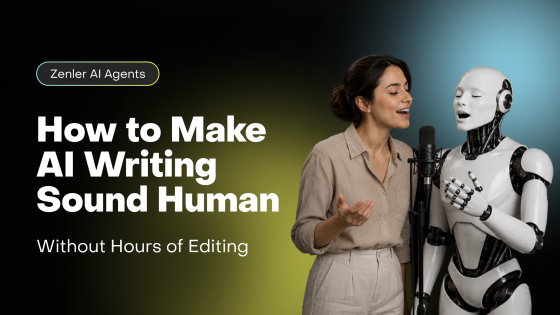
The biggest giveaway of AI writing isn't that it's wrong—it's that it sounds like everyone else. Here's how to make every word sound more like you.
Let's be honest.
We've all read AI-generated content that feels...
Flat.
Perfect.
Predictable.
It isn't necessarily bad writing.
It just doesn't sound like it came from a real person.
If you've ever copied text from ChatGPT into a document and immediately thought,
"That doesn't sound like me..."
you're not alone.
The good news is that this isn't really an AI problem.
It's a prompting problem.
And an editing problem.
Once you understand how AI produces content, making it sound human becomes surprisingly simple.
Quick Answer
To make AI writing sound human, start with your own ideas, give AI examples of your writing, build a reusable voice profile and always edit the final draft with your own stories, opinions and experience.
Quick answer: How to Make AI Writing Sound Human | Keep Your Own Voice explains how to make AI writing sound human using a simple voice profile, better prompts and a proven editing process that keeps your personality intact.
Why AI Writing Sounds Generic
AI isn't trying to copy your voice.
It can't.
Instead, it predicts the most likely next word based on everything it has learned.
That means it naturally drifts towards...
Average.
Safe.
Predictable.
If you ask:
"Write me a blog about email marketing."
You'll usually receive something that could have appeared on thousands of websites.
Technically correct.
Emotionally forgettable.
That's why so much AI content feels the same.
Remember Why People Follow You
Nobody subscribes because you know how to use ChatGPT.
They subscribe because of your experience.
Maybe you've built successful online courses.
Maybe you've coached hundreds of clients.
Maybe you've made mistakes that others can learn from.
Those experiences are impossible for AI to invent.
They're what make your content valuable.
Think again if you're trying to remove yourself from the writing process.
That's the opposite of what your readers want.
Build Your Own Voice Profile
This is probably the biggest improvement you can make.
Instead of starting every conversation with AI from scratch, create a document describing how you naturally write.
Include things like:
words you regularly use
phrases you never use
how formal you are
sentence length
humour
favourite expressions
formatting style
the type of examples you like using
your audience
your personality
The more context AI has, the less generic your writing becomes.
We do exactly this for the NewZenler blog.
It saves hours.
Start With Your Ideas First
One habit has made a huge difference to my own workflow.
I don't ask AI what to think.
I tell AI what I'm thinking.
Sometimes that's only five or six bullet points.
Sometimes it's a voice note I've transcribed.
Sometimes it's a rough outline.
Then I ask AI to organise everything into a logical article.
The difference is incredible.
Because the ideas started with me, the finished article still feels like mine.
AI simply helped polish them.
Stop Using One-Line Prompts
Here's a common example.
Write me a sales page.
That's hardly any information.
Now compare it with this.
Write a sales page for course creators who struggle to finish writing their first online course. Keep the tone conversational, optimistic and practical. Use short paragraphs, avoid corporate language and include examples from coaching businesses.
See the difference?
The second prompt gives AI direction.
The first leaves it guessing.
Better prompts almost always produce better writing.
Add Stories AI Doesn't Know
This is where your content becomes impossible to copy.
Tell readers about:
a student who surprised you
a launch that didn't go to plan
a coaching conversation
something you learned the hard way
an unexpected result
These small stories build trust.
They're also the type of detail AI simply can't generate.
People remember stories far longer than perfectly written explanations.
Edit Like You're Talking To One Person
Here's a trick I use all the time.
After AI has created the first draft, I imagine explaining the same topic to one person over coffee.
Would I really say:
"Utilise this robust framework to maximise engagement?"
Not a chance.
I'd probably say something like:
"This is much easier than it sounds."
or
"Here's what worked for me."
That simple editing pass removes almost all of the robotic feel.
Don't Chase AI Detection Scores
Lots of people are becoming obsessed with AI detection tools.
Personally...
I think that's the wrong goal.
Different tools produce different scores.
Some will flag human-written articles.
Others won't detect obvious AI text.
Rather than trying to beat detection software, focus on writing content that's genuinely useful.
Ask yourself:
Does this sound like me?
Would I actually say this?
Have I added my own experience?
Have I helped someone solve a real problem?
If the answer is yes, you're already heading in the right direction.
Keep One Consistent Voice Everywhere
Your audience shouldn't feel like they're talking to a different person depending on where they find you.
Your:
blogs
emails
landing pages
social media
webinars
should all sound like they're coming from the same person.
That's why having a reusable voice profile is so valuable.
Whether you're using ChatGPT, Claude or another AI platform, your personality remains consistent.
AI Is Still An Incredible Writing Partner
None of this means AI isn't useful.
Quite the opposite.
It can help you:
overcome writer's block
generate ideas
improve headlines
organise articles
rewrite awkward paragraphs
repurpose content
speed up editing
The secret is remembering who's in charge.
AI supports your writing.
It shouldn't replace your thinking.
Bringing Everything Together
If you're building a complete AI-powered content system, this article is only one part of the puzzle.
For a full breakdown of how to use AI across your marketing, take a look at our guide to AI copywriting for course creators — including how to build an efficient workflow without losing the personality that makes people trust you.
You'll also want to explore the best AI copywriting tools compared to find the right fit for how you work.
If you're creating regular blog content, our guide to AI blog writing is another great next step.
Related Posts
- Get a clear foundation with our guide to AI copywriting for course creators — covering workflow, tone and how to stay in control of your content
- Understand the basics with our breakdown of what AI copywriting actually is and why it works
- Find the right tool for your workflow with our comparison of the best AI copywriting tools
- Learn how to use AI for blog writing and publish consistently without running out of ideas
- Take your content further with our guide to SEO blog writing with AI — so your articles actually get found
- Discover how to use AI for LinkedIn posts that sound like you and grow your professional audience
Related AI workflow resources
Use these Zenler guides to connect AI ideas with practical course business workflows:
- How course creators can use AI agents without losing their brand voice
- AI course launch checklist for New Zenler creators
- AI agents for course creators: practical workflows and examples
Frequently Asked Questions
Why does AI writing sound robotic?
Most AI tools generate average language because they're predicting common patterns. Without context about your personality and audience, the writing naturally becomes generic.
Can AI write in my own voice?
Yes, but only if you teach it. Providing examples of your writing, a detailed voice profile and clear prompts dramatically improves the results.
Should I edit AI-generated content?
Absolutely. AI should produce the first draft. Your editing is what adds personality, experience, accuracy and trust.
Will Google penalise AI-written content?
Google focuses on helpful, high-quality content rather than whether AI assisted the writing. Original insights, expertise and useful information matter far more than the tool you used.
What's the easiest way to humanise AI writing?
Start with your own ideas, include real examples, shorten long sentences, remove corporate language and read the article out loud before publishing. If it doesn't sound like you speaking, keep editing.
What To Do Next
AI doesn't have to make your content sound robotic.
In fact, it can do exactly the opposite.
Use it to remove the repetitive work, keep your own experiences at the centre of every article and let your personality shine through.
Remember, your voice is your biggest competitive advantage.
Protect it.
Teach it to AI.
Then let AI help you share it with far more people.
Categories: : AI for Course Creators
Copyright © 2026 Zenler. All rights reserved.
Terms | Privacy Policy | Cookie Policy | Support