How to Turn a Podcast Into a Blog Post with AI
 David Zenler
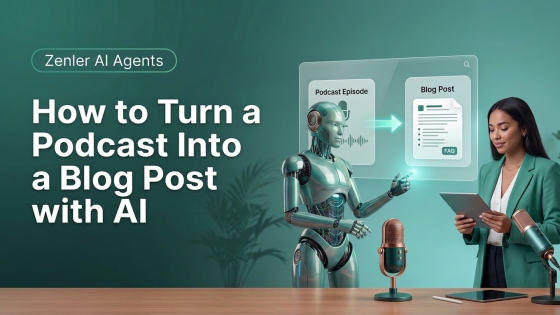
Learn how AI can turn a podcast transcript into a structured blog post with headings, summaries, examples and the creator’s voice.
Your podcast shouldn't only exist as audio. With AI, every episode can become a high-quality blog post that attracts search traffic, reaches new audiences and continues working long after the recording ends.
Turn Your Podcast Into a Blog Post with AI
Here's a question I often ask creators. "How many people actually listened to your last podcast?" Let's say it was a hundred. Maybe two hundred. That's great.
Now imagine that same episode also became an article for search, a LinkedIn post, a newsletter section, and a resource you could reference inside your online course.
Suddenly that one conversation has more chances to reach the right people in different formats. That's why I rarely think of a podcast as audio anymore. I think of it as the beginning of a content ecosystem.
Quick answer: AI can turn a podcast transcript into a structured blog post by organizing ideas, improving readability, creating headings, summarizing key points, expanding useful examples, and preserving the creator’s original voice and expertise.
Every Podcast Is Already A Blog
Most podcast episodes already contain everything needed for a great article. They have a clear topic, practical advice, real-world examples, personal stories and actionable takeaways.
The only difference is the format. Instead of spoken conversation, readers want clear structure. That's exactly where AI helps.
Step One – Create A Transcript
Everything starts with a transcript. Once your podcast becomes text, AI can begin organising it into something much easier to read.
A good transcript also becomes valuable for accessibility and AI Search. Instead of audio hidden inside an MP3 file, your expertise becomes searchable. That's a huge advantage.
Step Two – Find The Main Message
One mistake people make is trying to include every word from the recording. Don't. Most conversations naturally wander.
Instead ask, "What's the one big idea this episode teaches?" Everything else should support that idea. A focused article almost always performs better than one trying to cover everything.
Step Three – Create A Better Structure
Podcasts are conversational. Blogs need structure. AI can help organise your transcript into an engaging introduction, logical sections, clear headings, bullet points, practical examples, FAQs and a conclusion.
You're not changing the message. You're making it easier to consume.
Step Four – Add What The Podcast Didn't Include
This is where I think many people stop too early. A transcript isn't automatically a blog. Expand it. Add screenshots, examples, statistics, checklists, internal links and additional explanations.
The finished article should feel like a complete resource. Not just a transcript with headings.
Step Five – Optimise For AI Search
Today's content isn't just written for Google. It's also being read by AI-powered search engines. That means your article should answer questions clearly, use descriptive headings, include FAQs, explain concepts simply and link to related articles.
This gives AI systems much more context when deciding whether to reference your content. If you're new to this, read How to Optimise Your Content for AI Search.
Don't Lose Your Personality
Here's one thing AI can't recreate. The way you tell stories. Your jokes. Your experiences. Your opinions. Keep those.
They're often the reason people continue reading. AI should improve the presentation. Not replace your personality.
One Podcast Can Feed Your Entire Website
Think beyond one article. Every episode could become one pillar blog, several supporting blogs, newsletters, social media posts, course lessons, downloadable resources and webinar topics.
You're no longer creating content separately. Everything grows from one conversation.
Zenler Makes This Workflow Simple
Imagine publishing your podcast. Then using AI to create the companion blog, an email announcement, lesson notes, community discussions and promotional landing pages.
Everything remains connected inside your platform. That makes maintaining a consistent content strategy much easier.
Podcasting + Blogging = Authority
A podcast builds trust. A blog builds discoverability. Together they're far stronger than either one on its own. One speaks to people. The other speaks to search engines and AI systems. That's a combination that's difficult to beat.
Related Posts
Continue learning:
- AI Podcasting
- Best AI Podcast Tools
- AI Content Repurposing
- AI Blog Writing
- AI Content Calendar
- AI Copywriting
- How to Optimise Your Content for AI Search
Frequently Asked Questions
Can AI turn a podcast into a blog?
Yes. AI can organise a transcript into a structured article, create headings, expand key ideas and optimise it for SEO and AI Search.
Should I publish the transcript as it is?
Usually not. A transcript should be edited into a well-structured article that's easier to read and provides additional context.
Will this help SEO?
Absolutely. Blog posts created from podcasts make your expertise searchable and can rank in traditional search engines as well as AI-powered search.
Can I use the same podcast for multiple articles?
Yes. Many podcast episodes contain enough ideas to create several supporting articles covering different aspects of the discussion.
Why should I repurpose podcasts?
Repurposing allows you to reach people who prefer reading over listening while dramatically increasing the value of every podcast episode.
What To Do Next
The next time you record a podcast, don't stop after you hit publish. Turn that episode into a blog. Expand it. Improve it. Link it to your existing content.
Then let AI help you transform one conversation into an entire library of valuable resources. Your podcast deserves a much longer life than a single audio file.
Related content repurposing guide: AI content repurposing for creators.
Related AI workflow resources
Use these Zenler guides to connect AI ideas with practical course business workflows:
- How course creators can use AI agents without losing their brand voice
- AI course launch checklist for New Zenler creators
- AI agents for course creators: practical workflows and examples
Categories: : AI for Course Creators
Copyright © 2026 Zenler. All rights reserved.
Terms | Privacy Policy | Cookie Policy | Support